
For most U.S.-based professional teams, embedding an e-signature directly into your client portal or app via a vendor API or SDK delivers the best balance of security, UX, and automation. You control the signing experience, automate document lifecycle events through webhooks, and keep everything inside your existing workflow without forcing clients to jump between platforms.
Pick a different approach when:
- You need speed over customization: Prebuilt connectors for Salesforce, Microsoft 365, or Google Workspace get you live in days, not weeks.
- Your team has no developer resources: A redirect-based workflow or a low-code integration tool lets non-technical admins configure signing without writing code.
- You're on an enterprise content platform: Native e-signature integrations inside platforms like M-Files keep documents flowing without leaving your content management system.
Key Takeaways
The most effective e-signature integration for professional teams combines a vendor API or SDK with webhook-driven automation, U.S. ESIGN/UETA compliance, and a tamper-evident audit trail built into a single client-facing workflow.
| Point | Details |
|---|---|
| Choose your integration pattern first | API/SDK for full control, prebuilt connectors for speed, redirect for zero dev effort. |
| Verify compliance before signing a vendor contract | Require SOC 2 Type II, ESIGN/UETA documentation, and a BAA if HIPAA applies. |
| Secure credentials from day one | Store API keys in a secret manager; never hardcode them in source code. |
| Scope your POC to two weeks | One document type, one signer, one downstream system, audit trail exported. |
| Realclient for turnkey portal + signing | Realclient combines e-signatures, payments, and file sharing in one branded client portal. |
Table of Contents
- What does e-signature integration mean for U.S. businesses?
- Which integration approach fits your team?
- How to implement an e-signature integration step by step
- What security and compliance requirements should you verify?
- How do you choose the right vendor or integration approach?
- Where do e-signatures add the most value in real workflows?
- Realclient brings e-signatures and client management together
- What most teams get wrong about e-signature integration
- Sources
What does e-signature integration mean for U.S. businesses?
E-signature integration connects a signing service to your existing software so documents move from draft to signed to stored without manual steps. In the U.S., electronic signatures carry full legal weight under the federal ESIGN Act and the Uniform Electronic Transactions Act (UETA), which means a properly executed e-signature is as enforceable as ink on paper for the vast majority of commercial agreements.
The workflow touchpoints where an integration adds the most value:
- Sales contracts and proposals
- NDAs and service agreements
- Client onboarding forms and consent documents
- Invoices and change orders requiring approval
- HR offer letters, I-9 verifications, and policy acknowledgments
Every integration worth using produces a tamper-evident audit trail, timestamps each signer action, and stores a cryptographically sealed copy of the final document. Those three features are what make a signature defensible if a dispute ever reaches court.
Market context: Gartner's electronic signature market reviews show that buyers consistently rank audit trail completeness and integration breadth as their top two evaluation criteria, ahead of price.
Which integration approach fits your team?
Five patterns dominate the market. Each solves a different problem, and picking the wrong one costs you weeks of rework.
API and SDK embedding
You call the vendor's electronic signature API, pass a document and signer details, and receive back a signing URL or an embeddable session. Your app handles the UX; the vendor handles the cryptography. This is the highest-effort option (expect 40–80 developer hours for a production-ready build) and the most flexible. Signbee's developer guide shows how a prototype can be running in hours: generate a document, call the API, get a signing_url, then handle a webhook when the signature completes.

Best for: SaaS products, client portals, and any team that needs a fully branded signing experience.
Embedded signing (iframe or SDK)
The vendor renders the signing interface inside your app via an iframe or a JavaScript SDK. You get a near-native UX without building the signing UI yourself. PandaDoc's eSignature API documents this pattern well, including webhook hooks for lifecycle events and programmatic retrieval of signed PDFs and audit trails.
Best for: Agencies and small product teams that want a polished embedded experience with moderate dev effort (20–40 hours).
Redirect signing
Your app sends the signer to a hosted signing page on the vendor's domain, then receives a callback when signing completes. Setup is fast (a few hours), but the client leaves your branded environment.

Best for: Freelancers and solo operators who need a working solution quickly and can accept an off-brand signing page.
Prebuilt connectors
Vendors publish connectors for Salesforce, HubSpot, Microsoft Teams, Google Drive, and dozens of other platforms. eSignly's integrations catalog illustrates the typical range: CRM, HRIS, ERP, and cloud storage connectors, each wiring signing events into existing records without custom code. Zero to minimal dev effort; limited customization.
Best for: Sales, HR, and operations teams already living inside a CRM or HRIS who need signing without leaving their tool.
Native platform signing
Enterprise content platforms like M-Files surface pre-built e-signature integrations directly inside the content management layer. Documents never leave the platform, and signing events update metadata automatically.
Best for: Larger organizations with established document management systems and strict data residency requirements.
Pro Tip: Map your signing volume before choosing. If you send fewer than 50 documents per month, a prebuilt connector almost always delivers better ROI than a custom API build. Above that threshold, the API approach pays for itself in automation savings within a quarter.
How to implement an e-signature integration step by step
Follow these phases in order. Skipping discovery or QA is where most integrations go sideways.
- Discovery (1–2 days): Define document types, signer roles, authentication requirements, and storage destinations. Identify which systems need to receive signing events (CRM, HRIS, invoicing tool).
- Vendor selection and API key setup (1 day): Create a sandbox account, generate API keys, and store them in a secret manager (never in source code). Review rate limits and webhook documentation.
- Prototype (2–5 days): Build the minimal path: create a document, initiate signing, handle the completion webhook, and retrieve the signed PDF. Validate the audit trail output.
- Template and workflow configuration (2–3 days): Build reusable document templates, configure signer sequences, set expiration rules, and map field positions.
- Integration and storage wiring (3–7 days): Connect signing events to your CRM or database via webhooks. Configure document storage (cloud bucket, DMS, or portal). Implement redirect or iframe logic.
- QA and security review (3–5 days): Test authentication flows, webhook retry handling, failed-signature paths, mobile responsiveness, and audit trail completeness. Confirm encryption at rest and TLS in transit.
- Pilot launch (1 week): Roll out to a small internal or trusted-client group. Monitor webhook delivery rates, error logs, and signer completion rates.
- Go-live and monitoring (ongoing): Set up alerting for webhook failures and API errors. Schedule quarterly reviews of compliance certifications and SDK version updates.
Core tasks your team needs to own:
- Secure API credential storage (environment variables or a secrets manager like AWS Secrets Manager or HashiCorp Vault)
- Idempotent webhook handlers with exponential backoff on rate-limit errors
- Document version control: store the pre-signature draft and the countersigned final separately
- Access control: limit who can initiate, void, or download signed documents
What security and compliance requirements should you verify?
Security is not optional here. A signed document is only as defensible as the controls around it.
Authentication methods and when to use each:
- Email link: Sufficient for low-risk internal documents and standard commercial agreements.
- SMS one-time password (OTP): Adds a second factor; appropriate for client-facing contracts and onboarding forms.
- Knowledge-based authentication (KBA): Required by some regulated industries; verifies identity against credit bureau data.
- Digital certificate / qualified signature: Use when a transaction requires cryptographic proof of identity, such as high-value real estate or financial agreements. Zoho Sign explains that qualified electronic signatures use cryptographic certificates and are preferred for high-value or high-compliance transactions.
U.S. compliance checkpoints:
- ESIGN / UETA: Confirm your vendor documents compliance with both. Most major platforms do; verify it in the vendor's legal documentation, not just their marketing page.
- SOC 2 Type II: The baseline security certification to require for any SaaS signing vendor handling business data. Ask for the report, not just the badge.
- HIPAA: If you handle protected health information, your vendor must sign a Business Associate Agreement (BAA) and document HIPAA-eligible controls. eSignly's compliance documentation lists SOC 2, HIPAA, and ISO 27001 as certifications vendors in this space commonly advertise.
Security checklist for engineers:
- TLS 1.2 or higher on all API calls and webhook endpoints
- Tamper-evident audit trail with timestamps and IP addresses for every signer action
- Encryption at rest for stored documents (AES-256 is the standard)
- Webhook signature validation (verify the vendor's HMAC signature on every inbound event)
- Least-privilege access control on signing initiation and document retrieval
- Defined data retention and deletion policy
Pro Tip: Adobe's developer guidance recommends using integration or service account tokens stored in a secure secret manager rather than hardcoding credentials. This single practice prevents the most common production security incident in signing integrations.
Compliance note: SOC 2 Type II and HIPAA BAAs are contractual requirements in many enterprise and healthcare procurement processes. Confirm these before signing a vendor contract, not after.
How do you choose the right vendor or integration approach?
Focus your evaluation on three dimensions: technical fit, security and compliance, and cost.
Questions to ask every vendor:
- What SDK languages do you support, and how current is the documentation?
- What are your API rate limits, and what happens when we hit them?
- Do you offer webhook retry logic and delivery guarantees?
- Where is data stored, and can we specify U.S.-only data residency?
- What is your SLA for API uptime, and how do you communicate incidents?
- Do you provide a SOC 2 Type II report and sign a BAA if required?
Pricing models to budget for:
- Per envelope / per transaction: You pay each time a document is sent for signature. Predictable for low volume; expensive at scale.
- Per user seat: A flat monthly fee per team member who can send documents. Better for high-volume teams.
- API call tiers: Usage-based pricing on API calls, often with a free tier for prototyping. Common for developer-first platforms.
- Per account / flat subscription: One price for the account regardless of volume. Simplest to budget.
Red flags to walk away from:
- No exportable audit trail or audit trail locked behind a premium tier
- Webhook documentation that is incomplete or undocumented
- No dedicated developer support channel or sandbox environment
- Vague or missing data residency documentation
- Compliance certifications listed on the marketing page but unavailable as actual reports
For your proof of concept, scope it to one document type, one signer role, and one downstream system. Success criteria: document sent, signed, webhook received, signed PDF stored, audit trail exported. Two weeks is a realistic timeline for a focused team.
G2 user reviews consistently flag integration ease and webhook reliability as the factors that most often determine whether a team stays with a vendor long-term.
Where do e-signatures add the most value in real workflows?
Signing adds the most value at the moment a decision is made: contract acceptance, project kickoff, invoice approval, or policy acknowledgment. Getting that moment captured cleanly, with a full audit trail, is what the integration is actually for.
Use cases by team:
- Sales: Proposals and MSAs via CRM connector (Salesforce, HubSpot); redirect or embedded signing keeps deals moving without leaving the CRM.
- Legal: NDAs and vendor agreements via API with KBA authentication; full audit trail required.
- HR: Offer letters, I-9s, and handbook acknowledgments via HRIS connector; SMS OTP for identity verification.
- Finance: Invoice approvals and change orders via portal integration; webhook triggers payment release.
- Operations: Vendor onboarding and SOW approvals via embedded signing inside a client portal.
For freelancers and agencies, the most practical implementation is a branded client portal where the client signs, pays, and downloads deliverables in one place. Realclient is built exactly for this workflow. Clients get a private portal with contracts ready to sign, invoices ready to pay, and files ready to download. No email chains, no separate signing tool, no chasing.
Realclient has processed over $48 million in invoices through client portals, with e-signatures and payment collection built into the same workflow. That combination, sign then pay in one session, is what cuts the gap between project approval and payment receipt.
For a deeper look at how this works in practice, the e-signature document guide on the Realclient blog walks through the full signing flow for professional services teams.
Realclient brings e-signatures and client management together
Realclient is the direct alternative to stitching together a signing tool, a payment processor, and a file-sharing app. For freelancers, agencies, and small teams, the platform gives every client a private branded portal where they can review project updates, sign contracts, pay invoices, and download files without leaving a single workspace.
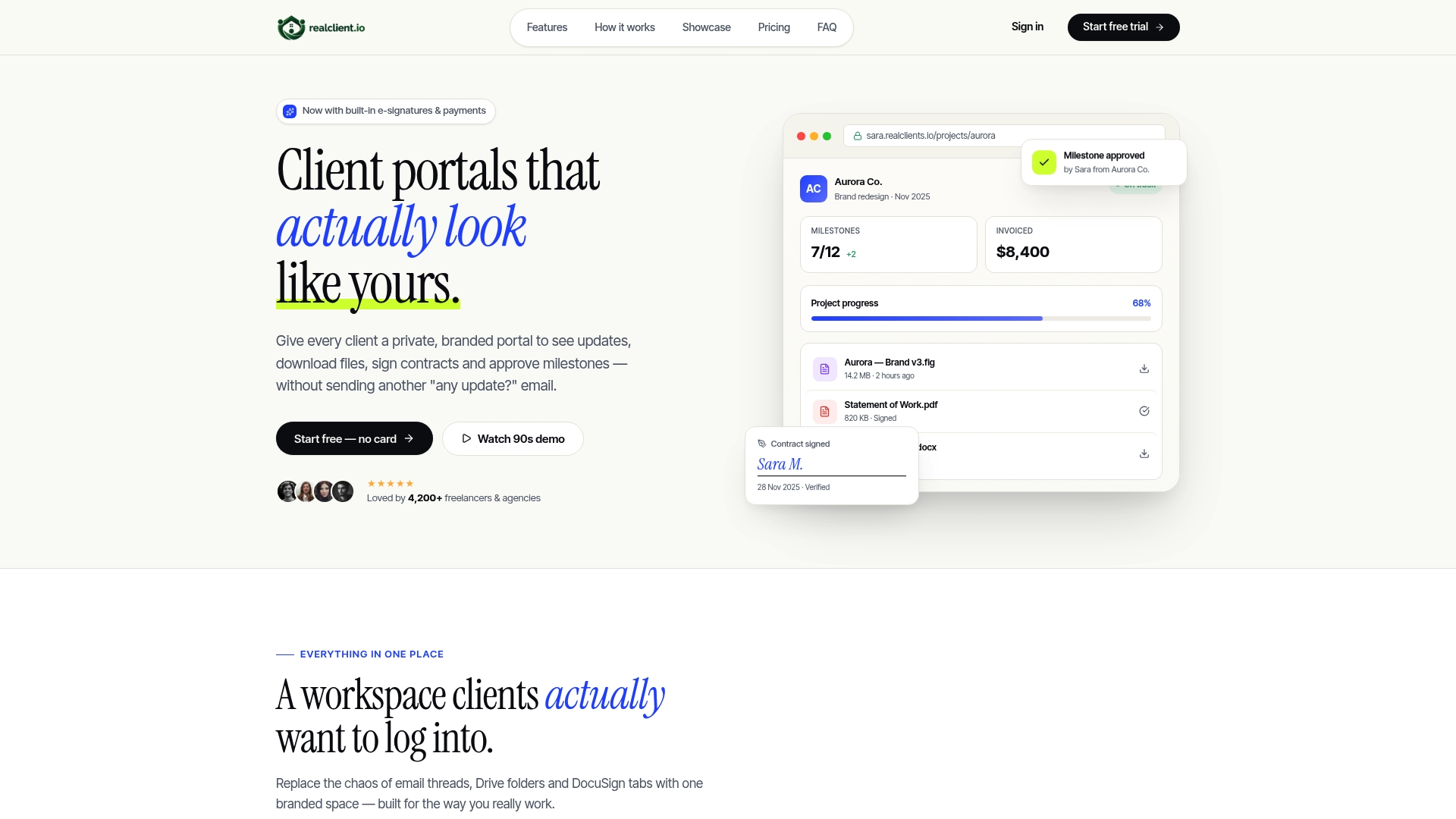
The e-signature and Stripe/PayPal payment integration are built in, not bolted on. You skip the API build, the webhook configuration, and the per-envelope fees that add up fast on a third-party signing tool. Bank-grade security, a full audit trail, and granular permissions are included on every plan. Realclient portals have processed a substantial amount of invoices recently, demonstrating this workflow works at real volume. shows this workflow works at real volume.
If you want a turnkey client portal with signing and payments already connected, start with Realclient and have your first portal live today.
What most teams get wrong about e-signature integration
The conventional advice is to pick the platform with the most integrations and the biggest name. That logic sounds safe, but it often leads teams to over-engineer a solution for a problem that is actually straightforward.
Most freelancers and small agencies do not need a full API build. They need a signed contract, a paid invoice, and a stored copy of both. The teams that spend weeks configuring a custom API integration for 10 documents a month are solving an engineering problem they do not have. The smarter move is to start with a portal that already connects signing and payment, prove the workflow with real clients, and only invest in a custom API build when volume or complexity genuinely demands it.
The other mistake is treating compliance as a checkbox rather than a design constraint. ESIGN and UETA give e-signatures legal standing, but only when the signing process itself is defensible: clear consent, a complete audit trail, and a tamper-evident final document. Those requirements should shape how you build the integration from the first prototype, not get bolted on before launch.
Pick the simplest approach that covers your actual volume and compliance requirements. Build the audit trail in from day one. And if you are a freelancer or small agency, a purpose-built client portal with signing already integrated will get you to a better outcome faster than any custom build.
Sources
Refer to these primary resources for API documentation and market context.
- Best Electronic Signature Reviews 2026
- Add E-Signatures to Your SaaS — No Template Engine
- eSignature Integrations & API | Connect Your Apps | eSignly
- Marketplace