
The fastest way to protect your next brand deal is to start with a proven content creator contract template. Three free, customizable options worth bookmarking right now:
- LawDistrict — attorney-reviewed influencer contract template, available in PDF and Word, covering scope, payment, usage rights, and FTC compliance
- Assembly — social media contract templates built for creators and agencies, with editable fields and plain-language clause explanations
- Venngage — visual content creator agreement templates with drag-and-drop customization, ideal for creators who want a polished, branded document
Every solid creator contract covers the same core ground: scope of work, payment schedule, content usage rights, exclusivity terms, IP ownership, FTC disclosure requirements, termination conditions, and the approval workflow. Download any of the templates above, fill in your specifics, and you have a legally grounded agreement ready to send before your next campaign kicks off.
Table of Contents
- What is a content creator contract and why do you need one?
- Key elements every content creator contract should include
- What do sample content creator contracts look like?
- How do US state laws affect your content creator agreement?
- What timelines should your contract set for review and delivery?
- How to avoid the most common content contract mistakes
- Realclient makes contract management part of your client workflow
- Key Takeaways
What is a content creator contract and why do you need one?
A content creator contract is a legally binding agreement between a creator and a brand that defines exactly what gets made, what gets paid, and what happens if either party walks away early. Without one, you have no legal recourse when a brand delays payment, requests unlimited revisions, or repurposes your content in ways you never agreed to.

The numbers back this up. Payment disputes drop by approximately 40% with clear contracts, and 42% of influencer-brand conflicts relate to payment issues. Those are preventable problems.
Beyond payment, a written agreement protects your creative rights. It clarifies who owns the content after delivery, how long a brand can run it as a paid ad, and whether you can show it in your portfolio. For US creators, it also documents your FTC compliance obligations, which the Federal Trade Commission enforces through its endorsement guidelines. A written contract for content creators is not a formality. It is the foundation of a professional business relationship.
Key elements every content creator contract should include
Eight clauses separate a contract that protects you from one that leaves you exposed. Here is what each one needs to say.
Scope of work
Define the exact deliverables: content format, platform, quantity, video length, file specs, and any required talking points. Vague scope is the single biggest driver of unpaid extra work. A clear scope reads like this: "3 Instagram Reels (15–60 seconds each), vertical format, delivered as .mp4 files, 2 revision rounds included."

Payment terms
The standard creator payment structure is 50% upfront and 50% upon final delivery. Avoid Net-60 or Net-90 terms whenever possible. If a brand insists on longer windows, negotiate a larger upfront deposit or add a late payment penalty of 1–2% per month. For a deeper look at how split payment structures work across different tools, that resource breaks it down clearly.
Content usage rights
Usage rights are the most underpriced element in most creator contracts. Limiting use by platform, format, and duration can increase your earnings substantially above your base rate. Organic reposts on brand channels are typically included in the base fee for a limited duration. Paid ad usage and perpetual rights usually require additional fees above the base rate. Never let "in perpetuity" slip through without premium pricing.
Exclusivity
An exclusivity clause restricts you from working with competing brands for a set period and should carry a premium on your base rate to compensate for that restriction.
Intellectual property ownership
By default, you own the content you create as an independent contractor. A "work for hire" clause transfers all ownership to the brand permanently, including your right to use the work in your own portfolio. Know which clause is in your contract before you sign.
FTC compliance
Your contract should state that all sponsored content will be disclosed per FTC endorsement guidelines, and that both parties share responsibility for compliance. This protects you if a brand pressures you to skip the disclosure.
Termination and kill fees
Kill fees typically amount to a portion of the total project fee to protect you when a brand cancels after work has begun. Your contract should specify the notice period required (7–14 days written notice is standard), what you are owed at each production stage, and that your upfront deposit is non-refundable.
Approval and revision workflow
A standard brand review window is a few business days. If the brand does not respond within that window, content is considered approved. Revision rounds are typically capped at 2–3 to prevent scope creep that erodes your margins. Anything beyond the cap gets billed separately.
Pro Tip: Add a "Client Responsibilities" clause that lists every asset the brand must deliver to you, with specific due dates. Client input deadlines automatically shift your timeline if the brand delays, keeping you legally protected and on schedule.
What do sample content creator contracts look like?
Seeing real contract language is the fastest way to understand what your own agreement should say. Here is how three popular free templates compare, along with a sample clause structure you can adapt.
Sample scope clause (adapted from common template language):
| Template | Format | Key strengths | Best for |
|---|---|---|---|
| LawDistrict | PDF, Word | Attorney-reviewed, covers all core clauses, plain language | Creators wanting legal credibility fast |
| Assembly | Editable online | Agency-friendly, SOW structure, multi-campaign ready | Agencies managing multiple brand deals |
| Venngage | Drag-and-drop | Visual customization, branded design, mobile-friendly | Creators who send polished client-facing docs |
Agencies handling multiple campaigns often benefit from a Master Services Agreement (MSA) paired with individual Statements of Work (SOW). The MSA locks in the static legal terms once. Each SOW then defines the deliverables, timeline, and pricing for a specific campaign without reopening the core agreement. This structure is especially practical when you work with the same brand across multiple projects throughout the year.
All three templates above offer PDF and Word downloads, making them compatible with e-signature tools and easy to customize in Google Docs or Microsoft Word before sending.
How do US state laws affect your content creator agreement?
US contract law is largely governed at the state level, and the state named in your governing law clause determines which rules apply if a dispute goes to court. California, New York, and Texas are the most common choices in creator contracts because they have well-developed case law around independent contractor agreements and intellectual property.
California creators should pay particular attention to AB5, the state's independent contractor classification law, which can affect how your working relationship with a brand is characterized legally. New York has its own freelancer protections under the Freelance Isn't Free Act, which requires written contracts for freelance work valued at $800 or more and gives freelancers the right to sue for double damages if payment is withheld. Always specify your governing state and choose one where you have legal standing to pursue a claim.
FTC endorsement guidelines apply federally, regardless of state. The FTC's updated rules require clear and conspicuous disclosure of any material connection between a creator and a brand, including gifted products, affiliate relationships, and paid partnerships. Your contract should assign disclosure responsibility explicitly so neither party can claim ignorance if a post gets flagged.
What timelines should your contract set for review and delivery?
A contract without dates is a contract without teeth. Build your timeline around three fixed points: the brand's asset delivery date, your draft delivery date, and the posting date.
A practical milestone structure for a standard sponsored post campaign looks like this:
- Brand delivers assets (product, brand guidelines, talking points): at least 10–14 days before the posting date
- Creator delivers first draft: 5–7 days after receiving brand assets
- Brand review window: 48–72 hours from draft delivery; silence equals approval
- Revision turnaround: 2–3 business days per round, capped at 2 rounds
- Final content approval: at least 3 days before the agreed posting date
- Content goes live: on the agreed date, with a minimum 30-day live period for feed posts
Tie every milestone to a calendar date in the contract, not a relative "X days after signing." Relative timelines create room for disagreement about when the clock started. Fixed dates remove that ambiguity entirely.
How to avoid the most common content contract mistakes
Most contract problems are predictable. Here are the ones that cost creators and brands the most time and money, and how to head them off.
Vague payment terms are the leading cause of disputes. Specify the total fee, the payment split, the invoice date, the due date, and the late payment penalty in the same clause. Leaving any of those fields open invites friction.
Uncapped revisions quietly destroy project margins. Without a revision limit, a brand can request changes indefinitely without paying more. Cap rounds at two, define what counts as a single "round" (one consolidated list of feedback, not piecemeal comments), and state the per-round fee for anything beyond the cap.
Missing kill fees leave you unprotected if a brand cancels after you have already done the work. A kill fee of 25–50% of the total project value is standard and should be non-negotiable.
Perpetual usage rights without premium pricing is the clause that costs creators the most money long-term. If a brand wants to run your content as a paid ad indefinitely, that is worth significantly more than a single organic post. Price it accordingly or limit the duration.
No FTC disclosure clause exposes both parties. The FTC can pursue enforcement actions against creators and brands alike, so both sides benefit from having disclosure obligations written into the agreement.
Here is a quick negotiation checklist for ongoing collaborations:
- Review and update usage rights terms at each contract renewal
- Adjust exclusivity premiums if the restricted category expands
- Add an amendment clause so both parties can modify terms in writing without voiding the original agreement
- Confirm that the governing law clause still reflects where you operate
Contracts are living documents when you work with the same brand across multiple campaigns. Specifying client input deadlines and building in a formal amendment process keeps the relationship clean as the work evolves.
Scope creep is the quiet profit killer in creator work. A contract that functions as an operational roadmap, with clear revision caps and defined client responsibilities, is the most practical defense against it.
Realclient makes contract management part of your client workflow
Once your creator contract is signed, the real work begins: tracking deliverables, collecting payment, and keeping communication organized. Scattered emails and manual follow-ups eat the time you should be spending on content.
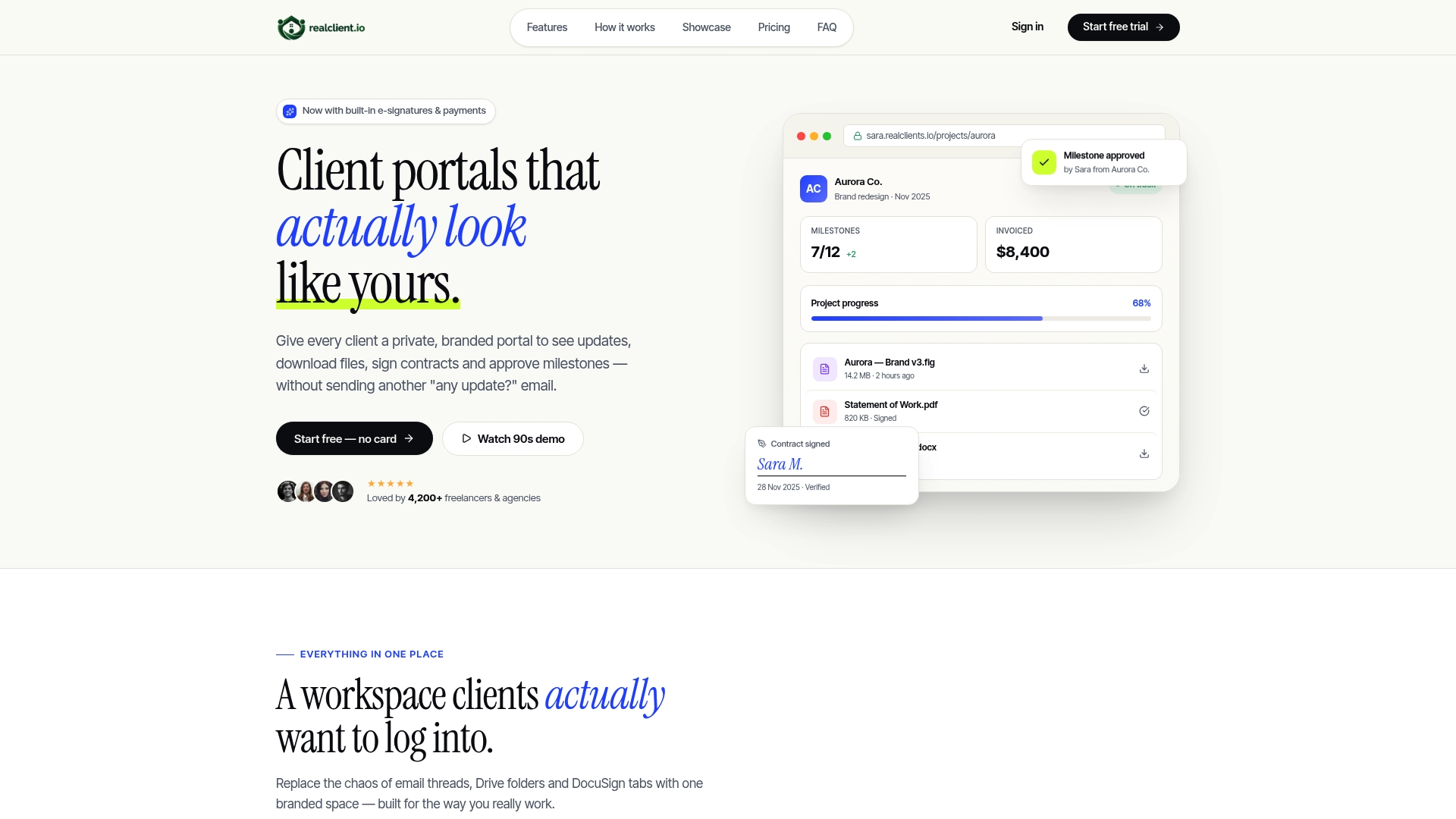
Realclient gives you a branded client portal where contracts, e-signatures, invoices, and project updates all live in one place. Your clients see a professional workspace instead of a cluttered inbox thread. You get built-in Stripe and PayPal integration, so the 50/50 payment split you negotiated in your contract gets collected automatically at each milestone. Realclient processed over $48 million in invoices through creator and freelancer portals last year. Explore plan options and see how it fits your workflow.
Key Takeaways
A solid content creator contract template covers eight core clauses and sets fixed dates for every milestone, giving both creators and brands a clear, enforceable agreement from day one.
| Point | Details |
|---|---|
| Start with a proven template | LawDistrict, Assembly, and Venngage offer free, customizable templates in PDF and Word formats. |
| Price usage rights correctly | Limiting content use by platform, format, and duration can increase your earnings by 25–200% over your base rate. |
| Use the 50/50 payment split | The standard structure is 50% upfront and 50% on final delivery to protect both parties. |
| Cap revisions at 2–3 rounds | Uncapped revisions erode margins; anything beyond the cap should be billed separately. |
| Manage contracts in Realclient | Realclient combines e-signatures, milestone payments, and client portals in one branded workspace. |