
Use this phased client onboarding checklist, pre-kickoff, kickoff week, first 30 days, to move a new client from signed contract to first deliverable without dropped tasks or scattered emails. That's the structure the best onboarding guides converge on, and it works because each phase ends with one clear output you can point to and say "done."
Here's what to do right now, before you read another word:
- Send the welcome message and workspace link within 24 hours of signing.
- Collect the signed contract before any work starts.
- Send the intake form with a short response deadline.
- Schedule the kickoff call for the first available slot in week one.
- Run an access and credential audit before the kickoff call.
Everything below expands these steps into a full phased checklist with owners, SLAs, and copy-ready templates. If you want the artifacts first, skip to the templates section.
Key Takeaways
A phased checklist with named owners and fixed SLAs, welcome within 24 hours, intake within 3 days, first deliverable by day 14, is what separates smooth onboarding from a client who churns before month two.
| Point | Details |
|---|---|
| Follow the three phases | Pre-kickoff, kickoff week, and first 30 days each end with one clear, checkable output. |
| Name an owner per step | Sales, account lead, project manager, and technical lead each own specific handoffs. |
| Hit the SLA windows | Welcome in 24 hours, intake in 3 days, recap in 4 hours, first deliverable by day 14. |
| Build templates once | Intake form, welcome email, and kickoff agenda get reused for every client, not rewritten. |
| Centralize in a portal | Realclient consolidates document status, e-signature, and milestone-based invoicing in one branded workspace. |
Table of Contents
- Client Onboarding Checklist: Every Step From Contract To First Deliverable
- How Long Should Each Onboarding Phase Take?
- Who Owns Each Onboarding Step?
- What Templates Do You Need Before Your Next Client Signs?
- Why Centralizing Onboarding In A Client Portal Changes The Math
- Which Onboarding Steps Should You Automate First?
- What Compliance Steps Belong In Onboarding?
- How Do You Protect Client Data During Onboarding?
- What Training Materials Do New Clients Actually Need?
- How Do You Align On Goals Before Work Begins?
- How Do You Turn Client Feedback Into A Better Process?
- Why Onboarding Deserves More Attention Than It Gets
- Put This Checklist Into A System, Not A Spreadsheet
- Sources
Client Onboarding Checklist: Every Step From Contract To First Deliverable
This is the version you paste into Asana, ClickUp, or Notion today. It's organized by phase because that's how the best-performing onboarding frameworks structure the work, including the phased approach Gatilab lays out in its 47-item onboarding playbook. Each phase has a hard exit condition: you don't move to kickoff week until pre-kickoff is fully checked off.
Phase 1: Pre-kickoff
- Confirm the signed contract and deposit have landed. Nothing else starts until this box is checked.
- Send the welcome email with workspace access, next steps, and a point of contact.
- Send the intake questionnaire with a firm 3-business-day deadline.
- Issue an NDA if the engagement touches sensitive data or unreleased products.
- Schedule the kickoff call and send a calendar invite with the agenda attached.
This sequence mirrors what Content Snare's onboarding template recommends: proposal, contract, payment, questionnaire, then kickoff, in that order, because reversing any of these steps almost always causes rework.
Phase 2: Kickoff week
- Run a 60-minute kickoff call built around a shared agenda: goals, scope boundaries, roles, timeline, and communication norms.
- Send the recap email within your SLA window (four hours is standard), listing decisions, owners, and dates.
- Confirm the communication plan: which channel for what kind of message, and how fast each side responds.
- Complete an access audit: logins, domain access, software permissions, brand assets, and any third-party accounts you need.
- Set up the shared project workspace and populate the milestone calendar with real dates, not placeholders.
Skipping the access audit is the single most common source of week-two delays. A client who "forgot" they still needed to grant analytics access can stall a launch by days.
Phase 3: First 30 days
- Ship the first deliverable, typically a two-week artifact that proves direction and builds trust early.
- Collect written feedback on that deliverable, not just a verbal thumbs-up on a call.
- Update the project plan based on that feedback before moving to the next milestone.
- Invoice the second milestone according to the payment schedule in the contract.
- Schedule the day-30 review and, if the relationship is going well, ask for a testimonial while the experience is fresh.
Conditional rows to add depending on your service line:
- Enterprise clients: add a security review step and, if required, a vendor risk questionnaire before access is granted.
- Bookkeeping and accounting engagements: request bank statements, prior-year P&L, and any existing chart of accounts during intake, not after kickoff.
- Retainer clients: add a recurring monthly check-in to the calendar during Phase 2 so it isn't forgotten later.
Build this as one master checklist with branching sections rather than five separate lists for five service types. A single checklist with conditional logic scales better than maintaining parallel documents that inevitably drift out of sync.
How Long Should Each Onboarding Phase Take?
Each phase has one job and one proof point. Pre-kickoff exists to confirm the client is contractually and financially committed, and it's done the moment the signed contract, deposit, and completed intake form are all in hand. Kickoff week exists to align on scope and access, and it's done when the recap has been sent and every login on your access list works. The first 30 days exist to prove value, and that phase closes when the client has given written sign-off on the first deliverable.
Suggested SLAs, drawn from patterns across leading onboarding guides:
- Welcome message sent promptly after signature.
- Intake form completed within a few business days of being sent.
- Kickoff recap delivered within a short SLA after the call ending.
- First deliverable shipped within about two weeks.
- Day-30 review completed around day 30, scheduled at kickoff, not chased afterward.
A pattern worth trusting: Gatilab's phased playbook maps these same checkpoints across a 7- to 30-day milestone structure, and Moxo independently arrives at a similar sequence in its 8-step onboarding workflow. When two frameworks built independently land on the same checkpoints, that's a stronger signal than either one alone.
Adjust the pace to the engagement type. A one-week sprint compresses everything into 48 hours; a retainer relationship can stretch pre-kickoff slightly to accommodate procurement, but kickoff week should never slip past day five. Enterprise engagements often need an extra review cycle for legal and security sign-off, so build that into your SLA rather than letting it eat into the 30-day window unannounced.
Who Owns Each Onboarding Step?
Onboarding breaks down when one person is quietly responsible for everything. Naming an owner for every step, and writing that owner into your project plan, is what separates a checklist that works from one that gets ignored after the second client.
| Step | Owner | Typical SLA | Expected Output |
|---|---|---|---|
| Contract & deposit | Sales | Before kickoff scheduled | Signed contract, payment received |
| Welcome + intake | Account lead | 24 hours / 3 days | Workspace access, completed intake form |
| Kickoff call & recap | Project manager | 4 hours after call | Shared agenda, recap with owners and dates |
| Access audit | Technical lead | Kickoff week | Verified logins and permissions |
| First deliverable | Project manager | Day 14 | Client sign-off, written feedback |
The sales-to-delivery handoff deserves its own attention: hand the project manager a brief that includes the client's stated goals, budget constraints, any promises made during the sales conversation, and red flags noted in negotiation. Missing context here is the number one cause of scope confusion in week two. Lock the day-30 review date during the kickoff call itself, not after, since it's the meeting most likely to get "we'll find a time" and then never happen.
What Templates Do You Need Before Your Next Client Signs?
Build these four artifacts once and reuse them for every client.
- Intake form: company name, primary contact, project goals, key stakeholders, list of logins or accounts you'll need access to, and hard deadlines. Realclient's free client questionnaire template covers most of these fields out of the box.
- Welcome email: clear next steps, a direct link to the client workspace, the name of their point of contact, and one immediate value asset, like a short getting-started guide.
- Kickoff agenda and recap: agenda drives the call; the recap captures decisions, owners, and dates, and goes out within your SLA window.
- Access checklist: every login, domain, and permission you need, tracked against status, not just a mental list.
Tool categories that make this run without friction: form builders for intake, e-signature for contracts, a project workspace for milestones, a client portal for centralized access, and invoicing tied to your payment schedule. HubSpot's free onboarding template pack is a solid starting point if you're building these from scratch.
Pro Tip: Save your kickoff agenda as a locked template and duplicate it for every new client. Editing a blank document from memory is how "confirm project goals" quietly disappears from the agenda three clients in.
Why Centralizing Onboarding In A Client Portal Changes The Math
Spreadsheets and email threads work fine for one client. By the fifth, someone's chasing a signature buried in a Gmail thread from three weeks ago. A client portal with per-client status states, Requested, Received, Overdue, turns that chase into a glance, which is the core benefit Agent UI's portal model is built around.
Set up these automations inside your portal:
- File upload triggers a status change from Requested to Received automatically.
- A received document triggers the internal task marked complete, no manual checkbox.
- Hitting a project milestone triggers the next invoice to send itself.
Realclient customers invoiced over $48 million through their portals last year, a number that tracks with what happens when e-signatures and payments live in the same workspace as the project files: fewer steps between "deliverable approved" and "invoice paid." Teams migrating off spreadsheets should start small: move the intake form and document checklist first, add e-signature next, then bring invoicing into the same freelancer client portal once the team is comfortable.
Which Onboarding Steps Should You Automate First?
Automate the parts that don't need a human touch, and protect the parts that do.
- Connect your intake form to your project management tool so a completed form automatically creates the project and triggers the welcome email.
- Set e-signature workflows for contracts so signed documents automatically unlock the next onboarding step.
- Tie invoicing to milestones so hitting "first deliverable approved" fires the next invoice without a manual reminder.
- Layer in one personal touch, like a short Loom walkthrough alongside the automated welcome email, so the client still feels like a person is behind the process.
The failure mode to watch for is over-automation without conditional logic: a bookkeeping client and a branding client shouldn't get the identical automated sequence, because their required documents and review cycles differ. Test every automation end-to-end with a dummy client before it touches a real one.
Pro Tip: Run your entire automated sequence against a test account before the next real client signs. Broken trigger chains are far easier to catch on a dummy project than to explain to a paying client mid-onboarding.
What Compliance Steps Belong In Onboarding?
Compliance isn't a separate workstream from onboarding, it's baked into the checklist itself. Contracts should specify data handling terms, scope boundaries, and liability before any work begins, and an NDA belongs in Phase 1 whenever a client shares proprietary information, financial records, or unreleased products.
Industry-specific requirements change what "compliant onboarding" looks like. A bookkeeper handling client financials needs signed engagement letters that meet the standards their licensing body requires. An agency working with healthcare clients may need a business associate agreement before touching any protected health information. A freelancer collecting payment information needs a process that doesn't store card numbers directly, routing through a processor like Stripe or PayPal instead.
Retention policies deserve a line item too. Decide, before the first client signs, how long you keep contracts, intake responses, and financial records after an engagement ends, and write that into your own internal policy so it's consistent across every client rather than improvised case by case.
If your onboarding checklist includes contract storage, build it around a system that keeps signed documents retrievable years later, not buried in an inbox that gets cleaned out. A structured contract management workflow solves this by keeping every signed agreement attached to the client record itself, searchable long after the original email thread is gone.
How Do You Protect Client Data During Onboarding?
The intake form is often the first place a client hands over sensitive information, so treat it accordingly. Collect only what you actually need. A marketing consultant doesn't need a client's banking details; a bookkeeper doesn't need their social media passwords. Every extra field you request is one more piece of data you're responsible for protecting.

Encrypt data in transit and at rest wherever you're storing it, and restrict internal access to whoever actually needs it for the engagement, not your entire team by default. If your process still routes sensitive files through personal email, that's the first thing to fix before adding any other automation. A client portal with granular permissions, where team members see only the projects they're assigned to, closes a gap that shared inboxes and shared drive folders leave wide open.
Access audits aren't just for onboarding smoothness, they're a security practice. Every login and permission you grant during Phase 2 should have a corresponding entry for when and how it gets revoked at project end. Teams that skip this step often discover, months later, that a former client contact still has access to a shared folder nobody remembered to lock down.
Document your data handling practices somewhere the client can actually read them, not just in dense legal language buried in the contract. A short, plain-language summary of what you collect, how long you keep it, and who can see it builds more trust than a lengthy terms document nobody reads past the first paragraph.
What Training Materials Do New Clients Actually Need?
Most onboarding failures aren't about missing deliverables, they're about clients not understanding how to use what you've built for them or how to work with you. Solve this with a short set of materials handed over during kickoff week, not scrambled together after the client asks the same question for the third time.
Pair it with a short walkthrough video, three to five minutes, recorded once and reused for every client in that service line. This is far more scalable than a live screen-share for every new sign-up.
For technical deliverables, a lightweight FAQ addressing the questions you get most often (how to request revisions, what "final" means in your process, how approvals work) saves real time. Update this document quarterly based on what clients are actually asking, not what you assumed they'd ask when you first wrote it.
Client education doesn't stop after kickoff. Build a short check-in into the day-30 review specifically asking whether the client knows how to use every tool and asset you've given them. It's a five-minute question that catches confusion before it becomes a complaint.
How Do You Align On Goals Before Work Begins?
Vague goals produce vague deliverables, and mismatched expectations are the root cause of most onboarding friction, a pattern experienced practitioners flag consistently: misaligned communication and unclear success criteria cause the bulk of early-stage disputes. The fix starts in the intake form and gets locked in during the kickoff call.
Ask specific questions during intake: what does success look like at 30 days, 90 days, and project end? What's explicitly out of scope? Who has final approval authority on deliverables? Vague answers here are a signal to dig deeper before kickoff, not after the first deliverable gets rejected for reasons nobody mentioned.
During the kickoff call, restate the goals back to the client in your own words and get explicit agreement before moving on. This single step catches a surprising number of mismatches, cases where the client meant one thing and the intake form captured something adjacent to it. Put the agreed goals, scope boundaries, and success metrics in the kickoff recap in writing, so there's a documented reference point if expectations drift later.
Revisit these goals at the day-30 review, explicitly. Ask whether the original goals still make sense given what's been learned in the first month, and update the project plan if they don't. Goals set on day one rarely survive untouched through an entire engagement, and pretending otherwise creates friction that a five-minute conversation could have prevented.
How Do You Turn Client Feedback Into A Better Process?
Feedback collection can't be an afterthought bolted onto the end of a project. Build it into the checklist at two points: after the first deliverable ships, and at the day-30 review, both times in writing, not just a verbal "looks good" on a call that nobody documents.

A short structured feedback form works better than an open-ended "any thoughts?" email. Ask three or four specific questions: was the deliverable what you expected, was communication clear, was anything confusing about the process, and what would you change. Specific questions get specific answers you can actually act on.
Use that feedback to update your master checklist, not just the individual client relationship. If three clients in a row mention confusion about the access audit, that's a signal to rewrite the welcome email, not just apologize to each client individually. Treat the checklist itself as a living document that improves every quarter based on real friction points, not a document you wrote once and never revisited.
The day-30 review is also the natural point to ask for a testimonial or referral, while the experience is fresh and positive. Clients who've just seen a smooth first month are far more likely to say yes than clients contacted three months later when the details have faded.
Why Onboarding Deserves More Attention Than It Gets
A single-source client portal reduces churn because it removes the ambiguity that makes clients nervous in month one, when they don't yet know if they made the right choice hiring you. Scattered emails and unclear next steps read as disorganization even when the actual work is excellent.
If your team is still finding its rhythm, run a weekly onboarding huddle until the SLAs stick without anyone needing a reminder. Fifteen minutes reviewing every client currently in onboarding catches slipping deadlines before clients notice them.
Treat the checklist itself as a product, not a document you wrote once. Revisit it every quarter, update it based on what actually went wrong with real clients, and it keeps earning its place in your process.
— Real
Put This Checklist Into A System, Not A Spreadsheet
Realclient is the practical way to run everything in this checklist without juggling five separate tools. Your intake form, contract e-signature, milestone tracking, and invoicing live inside one branded client workspace, so a signed contract can trigger the welcome sequence and an approved milestone can trigger the invoice without you manually chasing either.
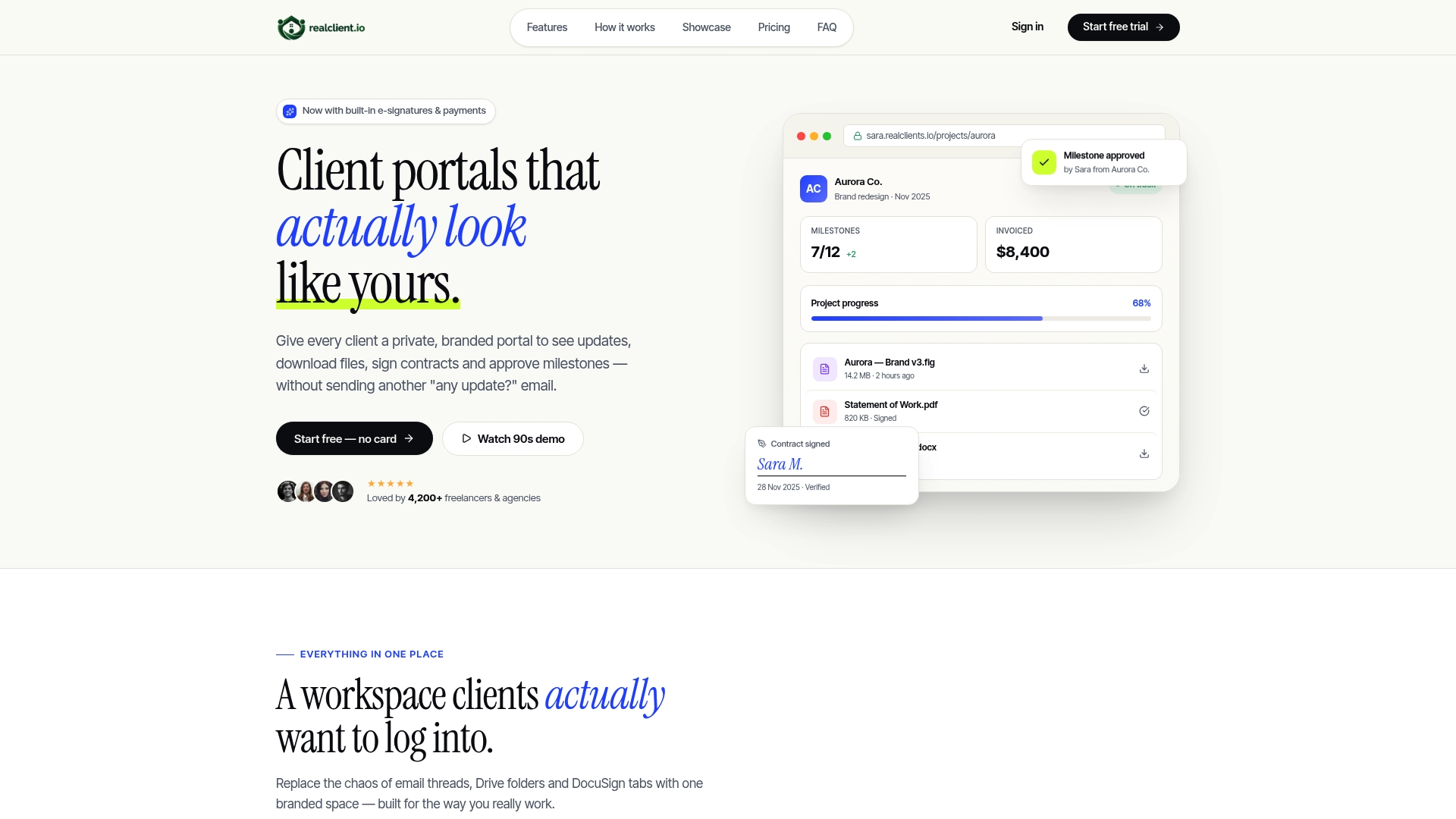
The document checklist states, Requested, Received, Overdue, mean you're not the one keeping track of who still owes what; the portal is. Branded portals also make the first-week experience feel intentional rather than improvised, which matters more than most teams expect when a client is still deciding whether they made the right call. If you want to see how other freelancers and agencies have laid theirs out before building your own, the client portal examples page is a good starting point.
Start with a free trial and set up your first client's portal before your next kickoff call. It takes less time than writing a welcome email from scratch, and you'll never write one from scratch again.
Sources
- Client Onboarding Checklist: 47-Item Playbook - Gatilab
- Free Customer Onboarding Templates - HubSpot
- New client onboarding done right: The process, checklist, and workflow you need | Moxo
- Client Onboarding Portal | Go Live in Days, Not Weeks | Agent UI