
That combination turns payment from a hope into an expectation built into the relationship from day one. If you take nothing else from this article, take that.
Here's what to do in the next hour:
- Open your contract template and change any "Net 30" or "Net 45" default to "Net 15," and add a deposit clause requiring 50% before work begins.
- Rewrite your invoice footer to state both the payment-terms label and the exact calendar due date (not just "Net 15" but "Net 15 — Due March 27, 2026").
- For your next new client, require the deposit through a payment link before you start, no exceptions.
While you're in there, watch for these three red flags in any contract someone hands you:
- Payment contingent on the client getting paid by their client (a "pay when paid" clause).
- No defined acceptance process, meaning the client can delay "approval" indefinitely and your payment clock never starts.
- Unlimited offset rights that let a client deduct disputed amounts from your invoice without documentation.
Fix these before you sign anything else, and the rest of this guide will show you exactly how.
Key Takeaways
Cash flow improves fastest when you pair short net terms with a deposit requirement and a written late fee clause, then enforce all three consistently.
| Point | Details |
|---|---|
| Set short defaults | Use Net 15 as your standard, reserving Net 30 only for clients who genuinely require it. |
| Require deposits on new work | A 50% deposit before starting protects against non-payers and no-shows on unproven clients. |
| Match contract and invoice wording | State the same payment-terms label and an explicit calendar due date on both documents. |
| Add an enforceable late fee | A 1.5% monthly clause with "lesser of" language holds up better against state rate caps. |
| Use a centralized portal | Realclient centralizes contracts, e-signatures, and payment links, helping generate the $48 million invoiced through its portals last year. |
Table of Contents
- What Are Client Payment Terms and Why They Control Your Cash Flow
- Payment Term Types: Exact Wording You Can Paste Today
- Choosing the Right Terms and Negotiating When Clients Push Back
- Late Fees: What's Reasonable and How to Enforce Them
- Copy-Paste Contract and Invoice Clauses
- Contract Red Flags That Delay Your Payment
- Putting Terms Into Practice: Billing, Reminders, and Collection
- How Client Portals Cut Down on Late Payments
- Further Reading and Primary Sources
- Frequently Asked Questions
- Sources
What Are Client Payment Terms and Why They Control Your Cash Flow
Payment terms are the conditions you set for when, how, and under what circumstances a client owes you money. They cover the due date, the payment window's start date, accepted methods, any discounts for early payment, and penalties for late payment. Stripe's own breakdown of invoice payment terms frames this as the full package: timing, method, discounts, and penalties working together, not just a due date scribbled at the bottom of an invoice.
Here's why this matters more than most freelancers realize. Payment terms don't just decide when you get paid. They decide how much of your own money is tied up in someone else's business at any given moment.
Quick math: Say you invoice $10,000 for a project. Under Net 60, that $10,000 sits in your client's bank account, earning them float, for two full months. Under Net 15, it's back in your hands in two weeks. If you run several projects a year at that size, the difference between Net 60 and Net 15 terms results in a substantial amount of your own cash being unavailable to you at any point in the cycle. That's not an invoice problem. That's a working-capital problem you created by not specifying terms up front.
Every payment-terms clause you write should nail down four things:
- Due date and start point — is the clock running from the invoice date, delivery date, or client acceptance?
- Accepted payment methods — ACH, card, PayPal, check, or a portal-based payment link.
- Late fee terms — the rate, how it compounds, and when it kicks in.
- Any discounts — early-payment incentives like 2/10 Net 30.
Skip any one of these and you've left room for a client to interpret the gap in their own favor.
Payment Term Types: Exact Wording You Can Paste Today
Not every client relationship calls for the same terms. A one-off logo design job and a six-month enterprise retainer shouldn't run on identical rules. Here's the full menu, with the invoice language to use for each.
Due on Receipt. Payment is expected immediately, or within a few business days. Best for small jobs, first-time clients with no track record, or anyone paying by card at checkout. Invoice wording: "Due on receipt — payment expected within 3 business days of invoice date."
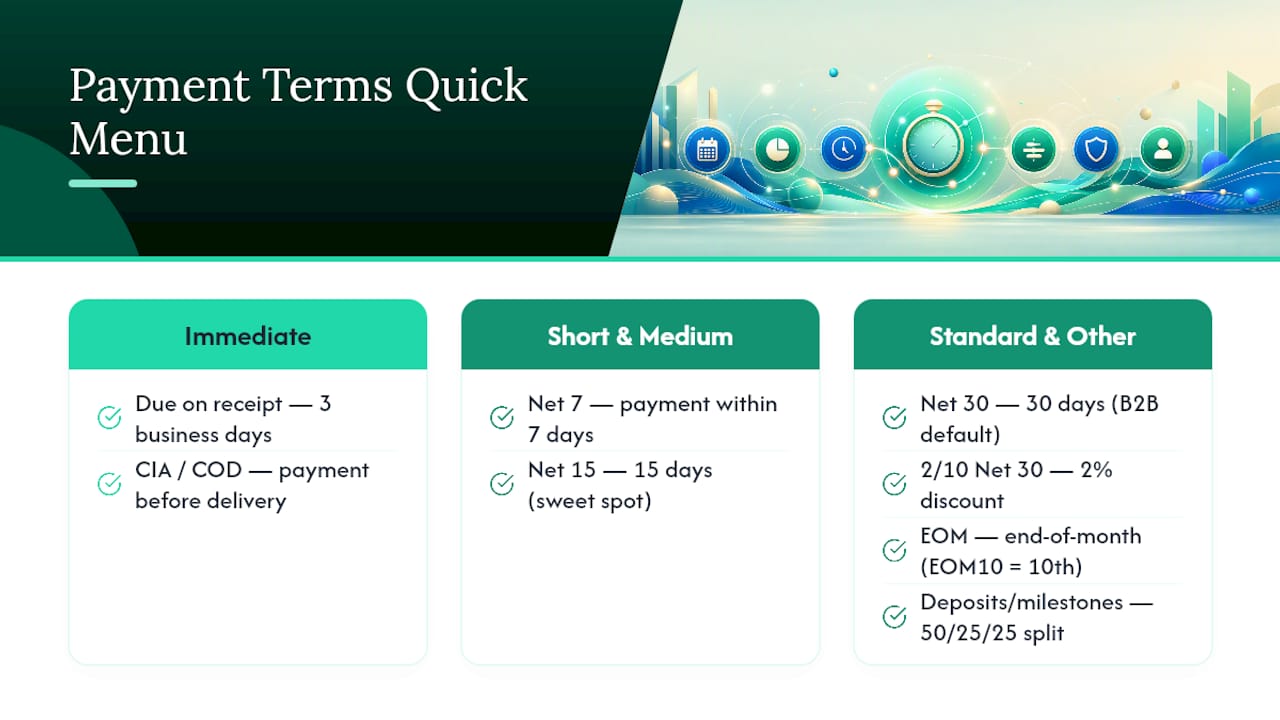
Net 7. A one-week window, common for smaller projects or clients you trust but still want paid quickly. Invoice wording: "Payment due within 7 days of invoice date (Invoice Date: March 10, 2026 → Due: March 17, 2026)."
Net 15. The sweet spot for most freelancers and small agencies. Shorter terms consistently get paid faster — invoices with 7-day terms tend to clear in about two weeks, while 30-day terms stretch closer to a full month, largely because clients treat the stated window as a soft target rather than a deadline. Invoice wording: "Payment due within 15 days of invoice date (Invoice Date: March 10, 2026 → Due: March 25, 2026)."
Net 30. Still the default in a lot of B2B work, especially with corporate clients whose accounts-payable departments run on monthly cycles. Treat this as your ceiling, not your starting offer. Invoice wording: "Payment due within 30 days of invoice date (Invoice Date: March 10, 2026 → Due: April 9, 2026)."
2/10 Net 30. A 2% discount if paid within 10 days, with full amount due within 30. This early payment discount can be worth offering because it accelerates cash flow without requiring negotiation. Invoice wording: "2/10 Net 30 — take a 2% discount ($4,900 total) if paid by March 20, 2026; full balance ($5,000) due by April 9, 2026."
EOM (End of Month). Terms run to the end of the month the invoice was issued, sometimes with an added grace period ("EOM 10" means the 10th of the following month). Common in industries with monthly billing cycles like agencies or wholesale. Invoice wording: "Net EOM 10 — payment due by the 10th of the month following invoice date."
CIA / COD (Cash in Advance / Cash on Delivery). Full payment before work starts or before goods/files are delivered. Reserve this for high-risk clients, custom work with no resale value, or anyone with a spotty payment history. Invoice wording: "Payment required in full prior to delivery of final files."
Deposits and milestones. For larger projects, splitting payment protects both sides. A common and effective structure is 50% up front, 25% at the midpoint, 25% on completion, tying each payment to a specific deliverable rather than a calendar date. Invoice wording: "Milestone 2 of 3 — Design Approval Phase — 25% of total project fee ($3,750) due upon written approval."
Retainers. A fixed monthly fee for ongoing availability, billed in advance rather than after work is completed. Invoice wording: "Monthly retainer — March 2026 — due by the 1st of the service month."
One detail trips up more freelancers than anything else on this list: where the clock starts. If your contract says "Net 15" but doesn't specify whether that's from the invoice date, the delivery date, or client sign-off, you've handed the client a built-in delay. Always anchor the start date to something you control, ideally the invoice date, and confirm delivery or acceptance separately in the contract.
Choosing the Right Terms and Negotiating When Clients Push Back
Your default terms should flex based on four things: how urgently you need the cash, how large the invoice is, how well you know the client, and what's normal in their industry. A first-time client paying $800 for a logo doesn't need the same scrutiny as a six-figure enterprise contract, but they also don't automatically deserve Net 30 just because they asked for it.
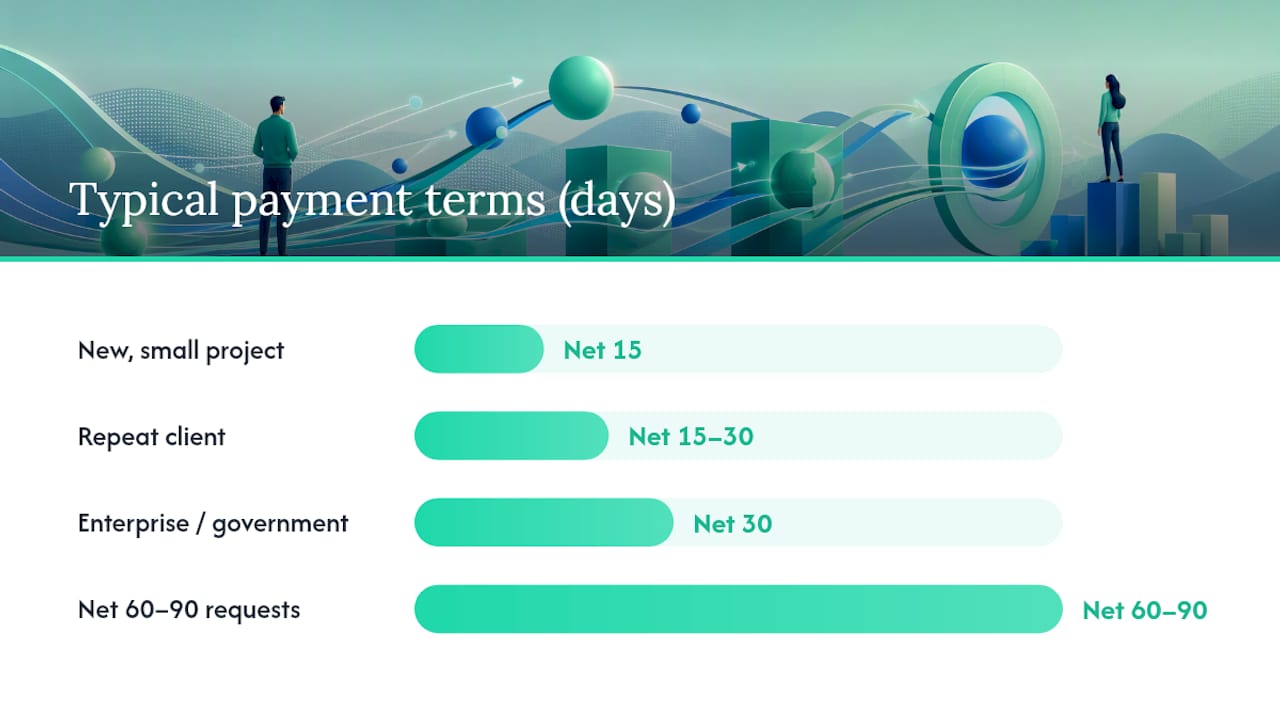
Here's how that plays out across common situations:
| Situation | Recommended terms | Why |
|---|---|---|
| New client, small project | 50% deposit + Net 15 on balance | No payment history yet; deposit protects against no-shows and non-payers |
| Repeat client, established trust | Net 15 or Net 30 | Track record justifies more flexibility |
| Ongoing retainer | Due on the 1st, billed monthly in advance | Predictable cash flow for both sides |
| Enterprise or government client | Net 30, larger deposit if possible | Corporate AP cycles rarely move faster, so offset with upfront cash |
| High-risk or unknown-industry client | CIA | Limits your exposure if the relationship falls apart |
| Large project (over $10,000) | Milestone payments (50/25/25 split) | Ties cash flow to deliverables instead of one big invoice |
When a client asks for Net 60 or Net 90, you're not stuck with a binary yes or no. Extended payment cycles effectively transfer working capital from you to them, so the goal is to offset that transfer, not just accept it. Three scripts worth having ready:
- The compromise offer. "I typically work on Net 15 terms, but I understand your accounts payable process runs longer. I can offer Net 30 if we add a 25% deposit up front to cover initial costs."
- The incentive flip. "My standard terms are Net 30, but I can offer a 2% discount if you're able to pay within 10 days — most of our clients find that works well with their AP schedule."
- The firm hold. "I'm not able to extend to Net 60 on projects of this size, but I'm happy to structure this as three milestone payments so the cash flow works better on your end too."
Pro Tip: Frame every terms conversation around how you run your business, not around what the client is comfortable with. "My standard terms are Net 15" reads as a policy. "Can I get paid faster?" reads as a favor you're asking for. Policies get respected; favors get negotiated down.
Late Fees: What's Reasonable and How to Enforce Them
A late fee only works if it's specific, reasonable, and written down before the invoice goes unpaid. The most common structure in freelance and small-business contracts is 1.5% per month, which works out to roughly 18% annualized. That rate sits comfortably within what most courts consider reasonable for commercial contracts, though the exact ceiling depends on your state.
A late fee clause exists to change behavior, not to punish. The goal is to encourage timely payment by making paying on time more appealing than paying late, so the incentive structure helps enforce payment without reliance on penalties.
Here's a sample clause you can adapt directly:
Invoices not paid within the stated terms will accrue a late fee of 1.5% per month
(or the maximum rate permitted by applicable state law, whichever is lesser) on the
outstanding balance. Client agrees to reimburse Freelancer for reasonable collection
costs, including attorney's fees, incurred in recovering unpaid amounts.
The "lesser of" language matters. This is genuinely a case where confirming your state's specific limit, rather than copying a number off a blog, protects you if a dispute ever escalates.
On the enforcement side, a workable escalation cadence looks like this:
- Day 1 past due: automated polite reminder
- Day 7 past due: firm follow-up referencing the late fee clause specifically
- Day 21 past due: formal notice with the late fee calculated and applied
- Day 45+ past due: consider a collections agency or small-claims filing, and consult an attorney if the amount justifies it
If you do government or public-sector work, the federal Prompt Payment Act sets specific timelines agencies must follow, and a growing number of states have passed their own freelancer-protection laws that set minimum payment timeframes and penalties for late payment on private contracts too. Check your state's specific statute before you rely on federal rules alone.
Copy-Paste Contract and Invoice Clauses
These are the exact clauses worth keeping in your contract template library. Format them, save them, and drop them into your next agreement without rewriting from scratch.
commencement of work. The remaining balance is due within 15 days of project
completion and delivery of final files.
Milestone schedule clause:
Kill fee clause:
If Client terminates this project after work has begun but before completion,

the remaining contract value.
Late fee and collection clause:
(or the maximum permitted by law, whichever is lesser). Client is responsible for
reasonable collection costs incurred in recovering unpaid balances.
Payment hold / dispute clause:
If Client disputes any portion of an invoice, Client must notify Freelancer in
writing within 5 business days of receipt, specifying the disputed amount and
reason. Undisputed amounts remain due per the original terms.
Accepted payment methods block:
Payment accepted via: ACH bank transfer, credit/debit card, or PayPal.
A secure payment link will be provided with each invoice.
On the invoice side, matching your contract language word for word matters more than most people realize. One of the most common causes of payment disputes is a mismatch between what the contract says and what the invoice says. If your contract says "Net 15 from invoice date" and your invoice just says "Net 15" with no calendar date attached, you've created ambiguity that benefits whoever wants to delay.
A clean invoice mockup should show:
Invoice #: 1047
Invoice Date: March 10, 2026
Payment Terms: Net 15
Due Date: March 25, 2026
Amount Due: $3,200.00

Payment Methods: ACH, Card, PayPal (link below)
If a client requests custom terms outside your standard template, document them in writing immediately: an email confirmation, a signed addendum, or a note in your contract management system all work, as long as the record exists before the invoice goes out.
Contract Red Flags That Delay Your Payment
Some clauses look harmless in a contract draft but quietly hand a client every incentive to pay you slowly, or not at all. Run through this list before you sign anything.
| Red flag clause | What it actually means | Recommended action |
|---|---|---|
| "Payment contingent on client's payment" | You get paid only after their client pays them, an open-ended delay outside your control | Reject, or narrow it to a documented pass-through with a hard outside date |
| No defined acceptance process | The client can call your work "unapproved" indefinitely, and your payment clock never starts | Add a clause: work is deemed accepted within 5 business days if no written feedback is given |
| Unlimited offset rights | Client can deduct any amount from any invoice without prior agreement or documentation | Limit offsets to pre-documented, mutually agreed deductions only |
| No late fee allowance | Silence on late payment means you have no contractual leverage if they pay slow | Add the standard 1.5% monthly clause before signing |
| No kill fee | If the project cancels midstream, you absorb all sunk costs | Add a kill fee tied to a percentage of completed work |
Before signing anything, run this five-item check:
- Do the contract's payment terms match what your invoice template will say, word for word?
- Is there a defined, dated acceptance process for deliverables?
- Are offset or deduction rights limited and documented, not open-ended?
- Does the contract explicitly allow a late fee?
- Is there a kill fee or cancellation clause protecting partial work?
If a clause fails one of these checks, redline it directly: replace "payment contingent on client's payment" with "payment due within 15 days of invoice regardless of client's own collection timeline," and note the change before you sign.
Putting Terms Into Practice: Billing, Reminders, and Collection
Setting good terms on paper means nothing if your billing process doesn't back them up. Here's the operational sequence that makes terms stick.
- Update your contract template with the clauses above, including deposit, late fee, and kill fee language.
- Update your invoice template so payment terms and the explicit due date appear together, not just a "Net 15" label floating with no calendar anchor.
- Set up automated reminders, ideally three days before the due date, on the due date, and at seven days past due.
- Require a deposit through a payment link for every new client before starting work.
- Log any custom terms a client negotiates in writing immediately, whether that's an email thread or a note in your project files.
Three reminder templates worth keeping on hand:
- First reminder (polite, pre-due): "Just a quick note that Invoice #1047 for $3,200 is due March 25. Let me know if you need anything from me to process payment."
- Firm late notice (past due): "Invoice #1047 was due March 25 and remains unpaid. Per our agreement, a 1.5% late fee now applies. Please remit payment or let me know if there's an issue I should be aware of."
- Pre-collections notice: "This is a final notice regarding Invoice #1047, now 30 days past due. If payment isn't received within 5 business days, I'll need to escalate this to collections."
On payment methods, offering options speeds things up more than most freelancers expect. ACH transfers are cheap but slower to clear; card payments cost more in fees but hit your account faster and remove friction for the client. A comparison of ACH versus card payments is worth reading if you're deciding which to make the default. PayPal splits the difference: fast and familiar, but with fees that add up on larger invoices.
Whatever you choose, the fewer steps between "invoice sent" and "client can pay," the faster you get paid.
How Client Portals Cut Down on Late Payments
Friction is the enemy of on-time payment. Every extra step between a client seeing an invoice and actually paying it is a chance for the payment to slip to the bottom of someone's inbox.
Freelancers and small agencies using Realclient's portals invoiced over $48 million through the platform last year, a scale that reflects what happens when payment links, contracts, and reminders live in one place instead of scattered across email threads and separate tools.
A few ways to make this work for your own terms:
- Require the deposit directly through the portal before work starts, so there's no separate email chase.
- Display the due date and a one-click payment button directly on the invoice view the client sees.
- Turn on automated reminders so the follow-up cadence runs without you manually tracking dates.
- Keep contracts, e-signatures, and payment records in one audit trail, which matters if a payment dispute ever needs documentation.
Centralizing acceptance, signature, and payment in a single client-facing space removes most of the ambiguity that causes late payment in the first place.
Balancing Fast Payment With Client Relationships
Cash flow protection and client trust aren't actually in conflict, even though it can feel that way when you're asking a new client for a deposit. The tension only shows up when terms feel arbitrary. Clients respect consistency; they push back on anything that looks improvised. My working rule: hold firm on deposits and late fees with every client, no exceptions, because that consistency is what makes the terms feel like policy rather than distrust. Where I'll flex is on the specific net-day window for a long-term client with a clean payment history. A simple line to keep in your back pocket: "These are my standard terms for every client, and I'm glad to walk through how they work."
Collect Faster With an Integrated Client Portal
Realclient puts your contracts, e-signatures, and invoicing in one branded client portal, so a client can approve a milestone and pay it in the same click instead of hunting through email for a payment link. That single-workflow setup is what pushed $48 million invoiced through Realclient portals last year, and it works because there's less friction between "work is done" and "payment is sent."
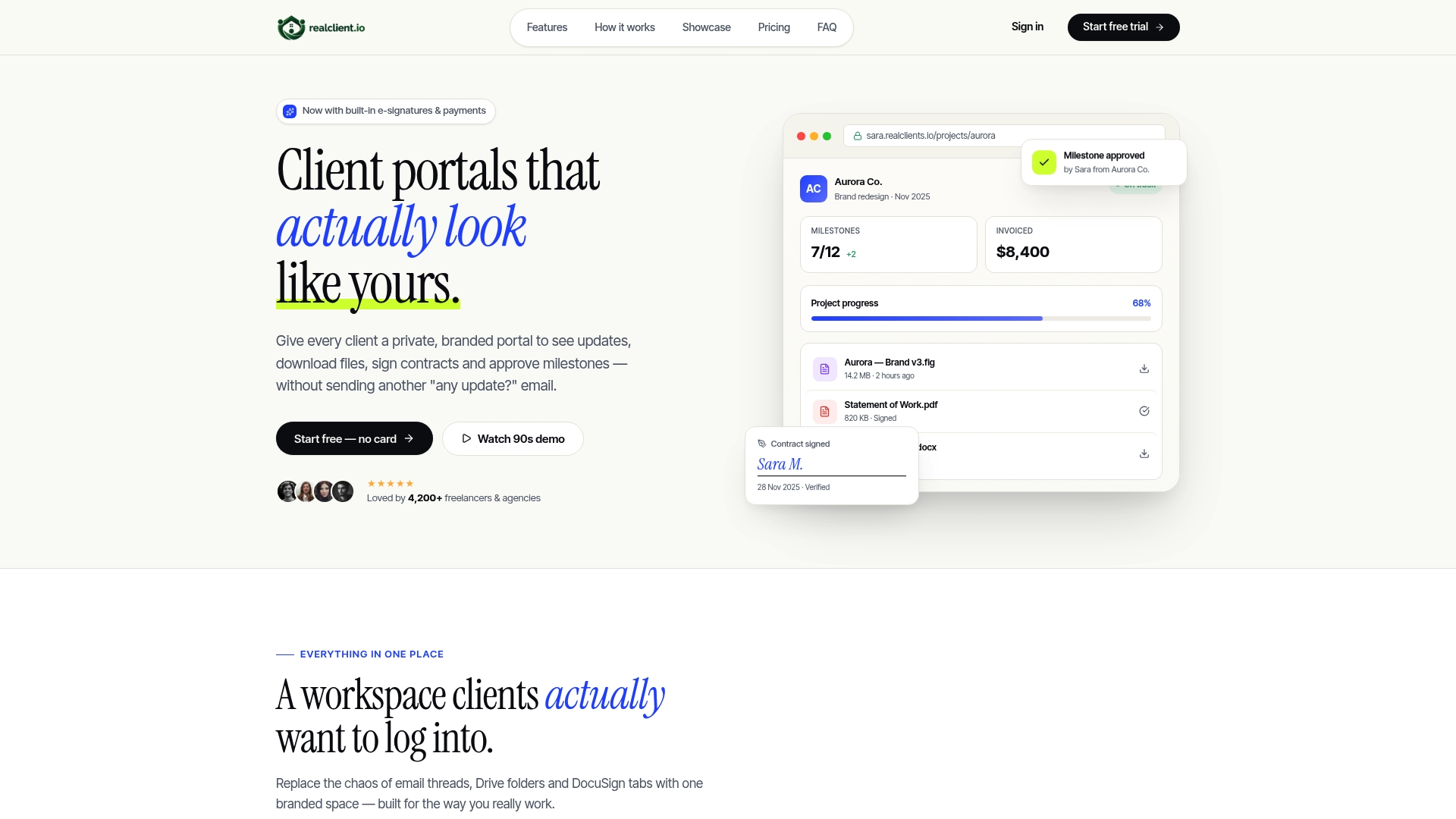
Every deposit, contract signature, and payment record lives in one place with bank-grade security, so you're not stitching together four separate tools just to enforce the terms you set in this article. If you're ready to stop chasing invoices through email, take a look at Realclient's plans and set up your first branded portal today.
Further Reading and Primary Sources
- Pact's guide to freelance contract payment terms covers deposit structures and late fee clauses in more depth.
- Stripe's primer on invoice payment terms breaks down the core components every terms clause should include.
- Xero's guide to invoice payment terms has data on how term length affects actual payment speed.
- The SBA is the place to check federal Prompt Payment Act rules and find links to your state's freelancer-protection statutes.
- If your billing runs on a recurring monthly model, this breakdown of pay-monthly service structures is a useful outside perspective on recurring cash flow planning.
Frequently Asked Questions
What are the most common client payment terms for freelancers? Net 15 and Net 30 are the two most widely used, with Net 15 generally recommended as a default because shorter windows correlate with faster actual payment. Due on receipt, 2/10 Net 30, and milestone-based schedules round out the common options depending on project size and client type.
Is Net 30 or Net 15 better for a small business? Net 15 tends to serve small businesses and freelancers better because it keeps less of your money tied up in a client's account at any given time. Net 30 remains standard for enterprise or government clients whose accounts-payable cycles rarely move faster, so reserve it for those relationships rather than defaulting to it across the board.
How much can I charge as a late fee on an unpaid invoice? A common industry rate is 1.5% per month, roughly 18% annualized, but the enforceable maximum depends on your state's usury and late-fee laws. Write the clause with "or the maximum permitted by applicable law, whichever is lesser" to stay protected regardless of jurisdiction.
Start with a firm written reminder referencing the specific clause in your signed contract, then apply the late fee as documented. If the balance remains unpaid past 30 to 45 days, escalate to a formal collections notice, and consult an attorney if the amount justifies legal action.
How do I negotiate payment terms with an enterprise client asking for Net 60 or Net 90? Offer a compromise, such as Net 30 combined with a larger upfront deposit, or propose an early-payment discount that gives them an incentive to pay sooner voluntarily. Extended terms shift working capital from you to them, so any concession you make should come with something in return, like a deposit or milestone structure.
Sources
- Payment clauses that protect your cash flow | Pact
- Invoice payment terms: what to include and common terms | Xero CA
- What are invoice payment terms? A primer for businesses | Stripe