
Granular client permissions mean controlling not just whether a user can log in, but exactly which actions, records, and fields they can touch once inside. The architecture that works reliably combines three layers: action-based permissions (view versus manage), record-level access (which rows or files belong to which client), and field-level visibility (which specific data inside a record they can see). Every layer must be enforced server-side, and only then should you let client-side admins delegate scopes to their own team members.
TL;DR:
- Implement server-side enforcement for action, record, and field-level permissions to prevent unauthorized data access even if the UI hides sensitive options.
- Use a permission catalog to define and map granular permissions, ensuring consistent access control and support for identity provider integrations like SSO and SCIM.
- Transition gradually from broad role-based permissions to granular controls, validating in shadow mode and obtaining client sign-offs before full migration.
- Conduct regular permission reviews and log all grant, revoke, and access events to detect over-privilege and ensure compliance with security standards like NIST or SOC 2.
- Focus on simple, consistent naming conventions and user-friendly interface displays that clarify permission effects to prevent accidental over-provisioning in client portals.
Table of Contents
- What Granular Client Permissions Are and Why They Matter
- Designing the Three Permission Layers: Action, Record, and Field
- RBAC, ABAC, or PBAC: Which Access Model Fits Your Portal?
- How Do You Implement Granular Permissions in Code?
- Migrating From Broad Roles to Granular Permissions Safely
- Enforcement, Logging, and Running Access Reviews
- Engineering Patterns: Middleware, Tokens, and Certificate Allowlists
- Governing Permissions at Scale: Delegation, SSO, and Offboarding
- Least Privilege and Just-in-Time Access, Explained
- Handling Permission Inheritance and Conflicts
- Performance and Scalability of Fine-Grained Permission Checks
- Best Practices for Displaying Permissions in a Client Portal
- Security Risks Unique to Granular Permission Models
- Testing Strategies for Verifying Permission Enforcement
- What Most Teams Get Wrong About Permission Design
- Get Granular Permissions Without Building Them From Scratch
- Sources
What Granular Client Permissions Are and Why They Matter
Coarse permissions treat access as a binary switch. A client either sees everything in a project or nothing. That model breaks down fast in any portal that handles contracts, invoices, or shared files across multiple clients, because "everything" almost always includes things a specific person shouldn't see, like another client's pricing or a teammate's internal notes.
Granular client permissions fix this by separating three concerns that coarse roles usually collapse into one. You control the action (can they view a file, or also delete it?), the record (can they see only their own project, or every project in the workspace?), and the field (can they see the invoice total, but not your internal margin note attached to that same invoice?). Panorays frames this as three distinct layers of granular permission control: action-based permissions, record-level access, and field-level visibility, and treating them as separate systems rather than one big role is what keeps the model from collapsing under real-world complexity.
The payoff shows up in three places:
- Security: a compromised client login exposes one record set, not your entire database.
- Compliance: auditors can trace exactly who could see what, and when, instead of a blanket "authenticated users" bucket.
- Client trust: agencies can safely let a client's own team members log in, without worrying that a new hire on their side stumbles into another department's contract.
Most portals started life as internal tools with simple page-level roles, and that shortcut is exactly why permission systems break once you scale past a handful of clients. Fixing it later means moving filtering logic out of the UI and into the database and API layer, which is a much bigger job than building it correctly from the start.
Designing the Three Permission Layers: Action, Record, and Field
Each layer solves a different failure mode, and skipping one leaves a gap the other two can't cover.
Action-based permissions answer "what can they do?" The cleanest pattern pairs every feature area into a view scope (read-only) and a manage scope (read and write), so a client can view invoices without being able to edit or delete them. Approvals deserve their own action entirely, separate from view or manage, because approving a contract is a distinct trust decision, not a side effect of having write access.
Record-level permissions answer "which rows can they touch?" This is tenant scoping: a client user query should never return another client's project by default. The critical detail is that this filtering has to happen in the database query or API layer, not in a UI component that simply hides rows. A client who opens their browser's developer tools shouldn't be able to see another tenant's raw API response just because the front end chose not to render it.
Field-level permissions answer "which parts of a record can they see?" A shared invoice record might include a client-facing total and an internal margin calculation. Field-level redaction has to happen server-side too. Sending the full record and hiding fields in the interface means the sensitive data already left your server, which defeats the point.
Here's how the three layers map onto common portal features:
- Files: action controls upload/delete, record scoping limits visibility to that client's project folder, field-level controls can hide internal metadata like storage cost tags.
- Billing: action controls who can issue refunds or apply credits, record scoping ensures a client only sees their own invoices, field-level controls hide your cost basis or margin.
- Approvals: a distinct action permission, separate from view/manage, tied to record-level scoping so a client can only approve their own contract, never someone else's.
Pro Tip: Build field-level redaction as a serializer-level rule tied to the user's role, not a conditional in your template code. Template-level hiding is the single most common way sensitive fields leak in portal rebuilds.
RBAC, ABAC, or PBAC: Which Access Model Fits Your Portal?
Role-based access control (RBAC) is the right starting point for most portals, and often the only model you'll ever need. You define a fixed set of roles like "client viewer" or "client billing manager," attach permissions to each, and assign users to roles. It's predictable, easy to audit, and simple to explain to a non-technical client admin.
RBAC starts to strain once your clients need permission combinations that don't fit neat role buckets. If one client wants their bookkeeper to see invoices but not files, while another wants the opposite, you either multiply roles indefinitely or move to something more flexible.
Attribute-based access control (ABAC) evaluates permissions dynamically based on attributes: the user's department, the record's status, the time of day, or the relationship between the user and the resource. ABAC handles per-client variance well because you write conditions instead of new roles for every edge case. The tradeoff is complexity: conditions are harder to audit at a glance than a role list.
Policy-based access control (PBAC) takes this further with a dedicated policy engine that evaluates more complex conditions like "allow approval only if the invoice is under $5,000 and the approver wasn't the creator." This is where you'd reach for tools like Keycloak's policy evaluation layer, which lets admins pre-check a policy change before it goes live.
- RBAC: best for portals with a handful of predictable client roles.
- ABAC: best when permission needs vary meaningfully client to client.
- PBAC: best for conditional business logic layered on top of either model.
Most mature systems end up hybrid: RBAC for the baseline structure, with ABAC or PBAC conditions layered on top for the exceptions that actually need them. Don't reach for a policy engine on day one just because it sounds more sophisticated.
How Do You Implement Granular Permissions in Code?
Naming conventions matter more than most engineering teams expect, because a permission system that's inconsistent to name becomes inconsistent to enforce. The pattern that scales is feature:action, such as invoices:view and invoices:manage. Make manage implicitly include view in your authorization logic. A user who can edit invoices should never lose the ability to see them, and enforcing that at the permission-check level avoids duplicate grants everywhere.
Build a permission catalog: a single source of truth listing every valid permission slug your system recognizes. This catalog does double duty. It documents what's possible for your own engineering team, and it exposes machine-readable slugs that plug directly into SSO group assertions, so an enterprise client's identity provider can map their own groups to your portal's permission slugs during login.
- Define the catalog first. List every action across every feature area before writing enforcement code, so you're not retrofitting permissions feature by feature.
- Enforce at the API and data layer, never only in the UI. Every request that touches a record must independently verify the caller's permission for that action, that record, and those fields. Hiding a button is not access control.
- Cache permission lookups with a short TTL. Checking permissions on every request against your primary database creates real load at scale, so cache the result per user, per tenant, per permission, but keep the TTL short (seconds to a couple of minutes) and invalidate immediately on any grant or revoke.
Pro Tip: When a client admin changes a permission, don't rely on cache expiry alone. Fire an invalidation event on the write path so the change takes effect on the next request, not after the cache happens to time out.
Migrating From Broad Roles to Granular Permissions Safely
The single rule that keeps a migration from becoming a security incident: never assign a granular permission unless the user's existing broad role already covered everything that permission grants. If "Editor" previously allowed viewing and editing invoices, the new invoices:manage permission is a safe, conservative mapping. If "Editor" never touched billing at all, don't grant invoices:view just because it seems logically adjacent. This conservative conversion rule, recommended for least-privilege migrations, prevents the most common migration failure: accidental privilege escalation baked into a well-intentioned automated conversion.
Run the new permission model in shadow mode before cutting over. Log what the new system would allow or deny for every real request, without actually enforcing it yet, and compare that against what the old system actually did. Any mismatch is a discrepancy you need to resolve before go-live, not after.
Before flipping the switch, generate a permission matrix export: every user, every role, every resulting permission, in one reviewable spreadsheet. Client admins should sign off on their own team's matrix before you migrate their tenant.
- Run shadow mode for at least one full billing cycle to catch edge cases in recurring workflows.
- Export a per-tenant permission matrix and get explicit sign-off from client admins.
- Keep the rollback path documented and tested, not theoretical.
- Communicate the cutover date to affected clients before it happens, not after something breaks.
Enforcement, Logging, and Running Access Reviews
Granular permissions only stay accurate if you watch them. Enforcement without logging is a black box; logging without periodic review is a paper trail nobody reads until after an incident.
Log every permission check that matters for audit purposes, not just failures. That means recording grants, revocations, approval actions, and denied access attempts, each tied to a timestamp, actor, and target record. This is the evidence base you'll need if a client ever asks "who could see this file" months after the fact.
Run access reviews on a fixed cadence rather than reactively. Quarterly reviews are common practice for portals handling financial or contractual data, and the review should specifically hunt for over-privileged accounts: users whose granted permissions exceed what their actual activity shows they use. An account with billing:manage that has never touched a billing record in six months is worth a second look.
Revocation needs to be immediate in effect, not eventual. If your permission checks rely on cached lookups, revoking a permission must also invalidate that cache entry, and any active session tokens tied to the old permission set should be treated as stale until refreshed.
- Log grant, revoke, approval, and denial events with actor and target record.
- Run quarterly (or more frequent) access reviews focused on over-privileged accounts.
- Invalidate cache and session state immediately on revocation, not on next natural expiry.
- Export logs in a format that maps cleanly to audit frameworks.
The NIST Cybersecurity Framework is the reference point most security teams use to map these controls to formal risk management categories, which matters if your clients ever ask for SOC 2 or similar evidence. Realclient's own guidance on SOC 2 readiness for client portals covers what auditors typically expect to see from an access-control log.
Engineering Patterns: Middleware, Tokens, and Certificate Allowlists
Most permission checks belong in a single, shared point in your request pipeline, not scattered across individual endpoints. A middleware layer that intercepts every API call, extracts the authenticated user's permission set, and checks it against the requested action and record before the handler even runs is the pattern that scales and stays auditable.
- Middleware-level check first. Reject anything that fails a basic action permission before the request reaches business logic.
- Record and field filtering inside the handler. Once past the middleware gate, the handler still needs to scope the database query to the caller's tenant and redact restricted fields from the response.
- Token scopes for service-to-service and long-lived sessions; per-request checks for anything sensitive. OAuth-style token scopes work well when you can predict access needs at token-issue time. Per-request checks matter more when permissions can change mid-session, like a revoked approval right.
For device or service-level access rather than human users, certificate-based allowlists are the more robust pattern. Microsoft's implementation for SMB over QUIC client access control restricts which clients can even establish a session, using certificate hash or issuer entries rather than per-client rules, which keeps the list manageable as device counts grow.
Deny entries in a certificate chain take priority over allow entries. If a client's certificate matches both an allow rule and a deny rule anywhere in the chain, the deny wins.
That single detail is worth internalizing for any allowlist/denylist design, not just certificate systems: deny-wins is the safer default whenever a permission model has conflicting rules that need a resolution order.
For multi-tenant message brokers or IoT-scale deployments, per-client ACL entries don't scale. Using substitution variables like client username or client ID inside ACL topic exceptions lets you write one rule that applies correctly across thousands of clients instead of one entry per client.
Governing Permissions at Scale: Delegation, SSO, and Offboarding
Letting client-side admins manage their own team's access inside your portal is one of the highest-leverage moves you can make, because it removes your team from the loop for routine changes and lets the client react immediately when their own staff changes. The tradeoff only works if delegated admin controls are themselves scoped tightly. A client admin should be able to add or remove users within their own tenant and adjust permission scopes you've explicitly made delegable, but never touch permissions outside their tenant boundary or grant themselves capabilities you didn't expose to them.
For enterprise clients running their own identity provider, SSO group assertions let their IT team manage role assignment on their end. Your permission catalog's machine-readable slugs map to their SSO groups, so a user added to "Finance" in their directory automatically receives the matching billing permissions in your portal. SCIM provisioning extends this to automatic account creation and deactivation, which matters enormously for offboarding: when someone leaves a client's company, their SSO deprovisioning should cut portal access immediately, not whenever someone remembers to log in and remove them manually.
Build a recurring hygiene habit around this:
- Certify each client's active permission list quarterly with their own admin.
- Prune permissions nobody has used in the last review cycle.
- Rotate or reissue any role that's accumulated permissions over time without a corresponding review.
Least Privilege and Just-in-Time Access, Explained
The principle of least privilege (PoLP) says every user should have the minimum access required to do their current task, nothing more. It sounds obvious stated that way, but most permission sprawl happens gradually: someone needed temporary access to a file eighteen months ago, got it, and nobody ever revoked it once the project ended.
Applying PoLP practically means defaulting every new client user to the narrowest useful role and requiring an explicit action to grant more, rather than defaulting to broad access and trusting people to ask for less. It also means treating "manage" and "view" as genuinely separate grants rather than always bundling them, since most users in a client portal only ever need to look, not edit.
Just-in-time (JIT) access takes this further by making elevated permissions temporary rather than standing. A client's accountant might need billing:manage for exactly the week they're reconciling invoices, then drop back to billing:view afterward. Rather than granting permanent write access "just in case," a JIT model issues a time-boxed elevation that expires automatically.
This matters more in client portals than in typical internal tools, because client-side turnover is invisible to you. An accountant who leaves their client's company doesn't trigger any signal on your end unless you built one. JIT access, paired with the SSO/SCIM offboarding hooks covered earlier, closes that gap without requiring your team to track every external personnel change manually. The narrower the standing grant, the less damage any single compromised credential can do, which is the entire point of the exercise.
Handling Permission Inheritance and Conflicts
Inheritance gets complicated fast once you have roles, tenants, and individual overrides all potentially granting or denying the same permission. The safest default is additive: a user's effective permissions are the union of everything granted to them, whether through their role, their tenant's defaults, or an individual override. Nobody loses access because of how grants happen to combine.
Subtractive models, where an explicit deny can override an allow from somewhere else, are sometimes necessary, but they need documented, strict conflict-resolution rules. The certificate-allowlist pattern discussed earlier is a good example: deny-wins is a defensible rule specifically because it's documented, consistent, and applied the same way everywhere in that system. The failure mode is a permission system where deny sometimes wins and sometimes doesn't, depending on which code path happens to run the check.
Where inheritance genuinely helps is reducing repetitive grants. A tenant-level default of files:view for every client user means you're not manually granting that permission to each new team member, and individual overrides can still add files:manage for the specific people who need it. The rule to protect is: overrides should only add access within an additive model, never quietly remove access a role grant provided. If you need true revocation at the individual level, make that an explicit, logged action, not a side effect of role assignment order.
Document your conflict-resolution rule in one place your engineering team can reference, and test it directly rather than assuming the intended behavior matches what the code actually does when two grants collide.
Performance and Scalability of Fine-Grained Permission Checks
Every fine-grained permission check adds a query or a lookup, and at scale that adds up. A portal checking permissions on every field of every record for every request will feel it in response times long before it becomes a security problem.
Caching is the standard fix, but it has to be designed carefully. Store cache entries keyed by tenant, user, and permission rather than caching an entire user's permission set as one blob, since that granularity lets you invalidate a single changed permission without wiping everything else out of cache. A short TTL, measured in seconds to a few minutes, keeps stale grants from lingering too long, paired with event-driven invalidation that fires the moment a permission actually changes.
Record-level filtering deserves particular attention because it usually means adding a tenant or ownership condition to every database query that touches client data. Done well, that's an indexed column check that costs almost nothing. Done poorly, as an application-layer filter applied after fetching too much data, it becomes a real bottleneck as your client base grows.
Field-level redaction has a similar tradeoff. Redacting fields at the serialization layer, right before the response leaves your server, is cheap. Redacting them by fetching everything and stripping fields in application code after multiple layers of processing wastes cycles and increases the chance a field leaks somewhere in between.
For very large deployments, particularly message brokers or IoT-style systems with thousands of clients, per-client permission entries stop scaling entirely. Substitution variables in ACL rules, covered earlier for topic exceptions, solve exactly this problem: one rule template instead of thousands of near-identical entries.
Best Practices for Displaying Permissions in a Client Portal
Permission systems fail in production more often from confusing interfaces than from broken code. A client admin who can't tell what a permission actually does will either grant too much out of frustration or file a support ticket you didn't need to receive.
Group permissions by feature area in your admin interface, matching the naming convention you built into your permission catalog. If your backend uses invoices:view and invoices:manage, your UI should show an "Invoices" section with a simple view/manage toggle, not a flat alphabetical list of forty permission strings.
Show the practical effect of a permission, not just its name. "Can approve contracts" is clearer to a client admin than contracts:approve, even if the underlying slug matters for your engineering team. Consider a brief inline description next to less obvious permissions, especially ones with security implications like billing access.
Make the current effective permission set visible and exportable. Client admins should be able to see, at a glance, exactly what a given team member can currently do, ideally as a single screen rather than something they have to reconstruct from multiple role assignments and overrides. Realclient's approach to portal layout and role-based views covers how this kind of clarity gets built into the interface itself rather than bolted on afterward.
Warn before granting anything broad. If a client admin is about to grant billing:manage to a new user, a simple confirmation showing exactly what that unlocks prevents a large share of accidental over-provisioning, which is far cheaper to prevent at the interface than to catch in a later audit.
Security Risks Unique to Granular Permission Models
Granular systems solve the coarse-access problem but introduce their own failure modes if you're not deliberate about them.
The most common one is UI-only enforcement: hiding a button or a menu item without actually blocking the underlying API call. Any client user with basic technical curiosity can inspect network requests and discover the endpoint still responds. Every layer discussed in this guide, action, record, and field, has to be enforced server-side, with the UI acting purely as a convenience, never as the actual gate.
Permission sprawl is the second major risk: dozens of granular permissions accumulating on accounts over time until nobody can say with confidence what a given role actually allows. This is why periodic access reviews matter as much as the initial design. A permission system audited once at launch and never again drifts toward chaos within a year or two.
Cache staleness creates a narrower but sharper risk: a revoked permission that's still honored for the length of a cache TTL. If your TTL is measured in minutes and your invalidation isn't event-driven, a revoked user retains access for exactly as long as your caching strategy allows, which is a real gap during an active offboarding or security incident.
Conflicting grant logic rounds out the list. A system that sometimes treats permissions as additive and sometimes allows a subtractive deny sneaking in, without a documented and consistently applied resolution rule, will eventually produce access decisions nobody can explain after the fact. Document one rule, apply it everywhere, and test that the code actually matches the documentation.
Mitigating all four comes down to the same discipline: enforce server-side, review on a schedule, invalidate fast, and keep conflict resolution simple enough to explain in one sentence.
Testing Strategies for Verifying Permission Enforcement
Permission logic is exactly the kind of code that looks correct in a quick manual check and fails in production for the one combination nobody tested. Automated coverage matters more here than in almost any other part of a portal's codebase.
Write negative tests as the priority, not just positive ones. It's easy to test that a user with invoices:manage can edit an invoice. It's far more valuable to test that a user with only invoices:view gets rejected when attempting the same edit, at the API level, not just in the UI. Every permission combination should have at least one test asserting what it explicitly cannot do.
Test record-level scoping with actual cross-tenant attempts. Create two test tenants, attempt to access tenant B's records using tenant A's credentials, and assert a denial every time. This is the single most common gap that manual QA misses, because it requires deliberately trying to break tenant isolation rather than testing the happy path.
Use policy pre-evaluation tools where your access model supports them. Systems like Keycloak's fine-grained admin permissions include an evaluation tool that lets an admin check what a policy change would actually allow before applying it in production, catching unintended consequences before they affect real users.
Run shadow-mode comparisons, the same technique used in migration, as an ongoing regression check, not just a one-time migration tool. Periodically replaying real traffic against your permission logic and diffing the result against expected outcomes catches drift introduced by unrelated code changes long before a client notices something's wrong.
What Most Teams Get Wrong About Permission Design
The conventional advice on access control treats it as a one-time architecture decision: pick RBAC or ABAC, build the roles, ship it. That framing misses the part that actually determines whether the system holds up: migration discipline and ongoing review. Most permission failures aren't design failures. They're drift, an over-provisioned account nobody revisited, a UI-only check that shipped under deadline pressure, a cache that never got event-driven invalidation.
If you take one thing from this guide, take the conservative conversion rule from the migration section: never grant more than the existing role already allowed. That single constraint prevents more real-world security incidents than any clever policy engine, because it removes the human error of guessing what a permission "probably" should include. Sophisticated ABAC or PBAC systems are genuinely useful, but they're overrated as a first move. Most portals need disciplined RBAC with server-side enforcement long before they need a policy engine.
Prioritize enforcement location over model sophistication. A simple role system enforced correctly at the API and database layer beats an elegant attribute-based model with a UI-only gate, every time.
— Real
Get Granular Permissions Without Building Them From Scratch
Building the three-layer permission architecture this guide describes, action, record, and field, from scratch means months of engineering time before you've shipped a single client-facing feature. A branded client portal solution provides that structure built in, so you're configuring permission scopes instead of coding a middleware layer.
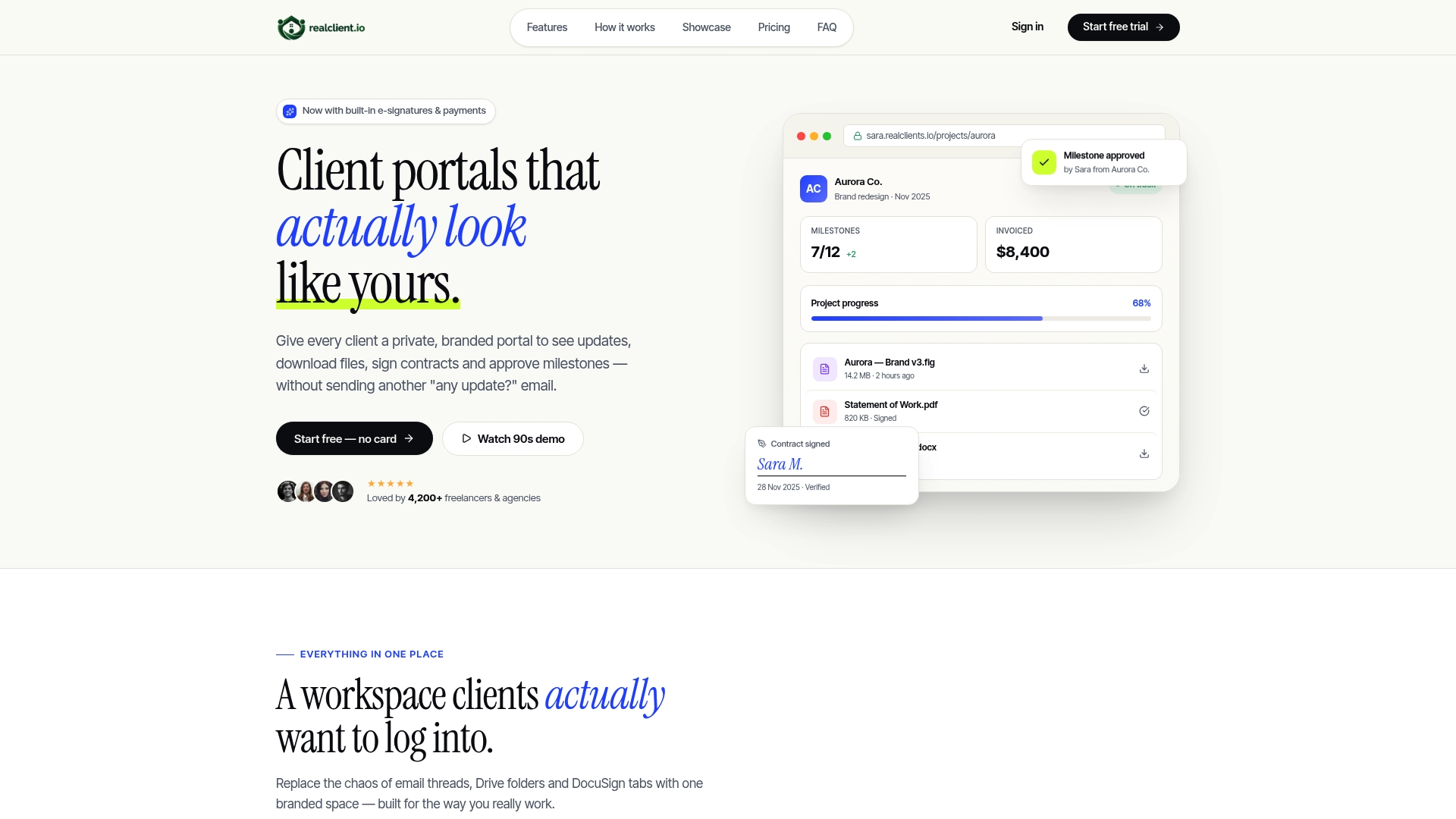
Inside Realclient, delegated client-side admins can manage their own team's access to files, messaging, contracts, and invoices without your involvement in every routine change, the same delegation pattern this guide recommends as high value. E-signatures and payment processing sit inside the same permission-scoped workspace, so a client's bookkeeper can see invoices without ever touching contract files. Portals have carried over a significant volume of invoiced payments through that structure. If billing permission scopes matter to your setup, pairing your portal with a dedicated payment partner like PaySec's processing for professional services is worth considering alongside your access-control plan.
Check the Realclient plans to see which tier matches your client count and team size, or visit Realclient to set up your first branded portal and start assigning permission scopes today.
Sources
For deeper technical grounding, review the NIST Cybersecurity Framework and platform-specific documentation like the Keycloak fine-grained admin permissions guide.
- Why Do Organizations Need Granular Permission Control?
- Principle of least privilege (PoLP) and permission patterns
- NIST Cybersecurity Framework