
A freelance retainer agreement is a written contract that secures ongoing access to your time or a defined set of deliverables in exchange for a recurring fee. There are two practical models: pay-for-work retainers, where the client prepays for a set volume of output, and pay-for-access retainers, where they're paying to keep you on call. Retainers make the most sense for continuing relationships, not one-off jobs.
TL;DR:
- Pay-for-access retainers reserve your availability and respond to priority requests, while pay-for-work retainers prepay for specific deliverables or hours each cycle.
- Clear clauses on scope, fees, overage rates, and termination are essential, with a focus on transparency about refundability and rollover policies.
- Pricing should be based on your hourly rate times reserved hours or a discounted flat fee, with advance billing preferred to protect cash flow.
- Managing a retainer effectively requires automated tracking, usage alerts at 80 percent, and proper documentation to avoid disputes.
- Use a branded portal to centralize contracts, invoices, and usage data, enhancing client trust and reducing administrative chaos.
Table of Contents
- What is a freelance retainer agreement and when should you use one?
- Types of retainers and why the label matters
- Essential clauses every retainer agreement should include
- How should you price and structure retainer fees?
- Running and managing your retainer without the chaos
- Common pitfalls and how to negotiate a better retainer
- Sample retainer clauses you can adapt today
- What retainers actually do for your business
- Let Realclient run the retainer while you run the work
- Sources
What is a freelance retainer agreement and when should you use one?
A retainer agreement differs from a project contract in one key way: it's built for repetition, not completion. A standard statement of work defines a start, a finish, and a fixed price. A retainer defines a recurring cycle, usually monthly, with no natural end date until either party gives notice.
That structural difference matters more than it sounds. Project contracts protect you against scope creep on a single deliverable. Retainers protect your income stream across dozens of small requests that would be exhausting to quote individually.
You'll know a client relationship fits a retainer when you notice a few patterns:
- The workload is steady, not sporadic. You're doing similar work every week or month, not once and done.
- The client needs priority access to you rather than a single output. They want to know you'll answer the email on Tuesday, not just deliver the file by Friday.
- The output is repeatable. Blog posts, ad management, bookkeeping, and legal counsel all fit this mold. A one-time brand redesign does not.
Marketing retainers, PR retainers, ongoing SEO work, and legal counsel are the classic examples. Continuous services like paid ads and SEO work well under a retainer specifically because the value compounds over time. A logo design or a single website build doesn't.
Types of retainers and why the label matters
Not all retainers work the same way, and the label you choose has real consequences for whether the client can get their money back. Retainer agreements generally take one of three forms: general, security, or advance payment. Freelancers usually simplify this into four working categories.
- Pay-for-access retainers reserve your availability. The client pays for priority and responsiveness, not a specific deliverable count.
- Pay-for-work retainers prepay for a defined block of hours or outputs each cycle, like 20 hours of design work or four blog posts a month.
- Security or advance retainers function like a deposit held against future invoices, drawn down as work happens.
- Evergreen retainers replenish automatically once the balance drops below a set threshold, keeping a rolling minimum on account.
The label affects refundability. A security retainer generally must be returned if the funds go unearned, while a flat access fee for reserved time is often treated as earned the moment the period begins, whether or not the client used your full availability. Decide up front how you'll actually handle the money, then write the clause to match that practice rather than picking language that sounds better. Courts and clients alike tend to look past a label to how the funds were actually handled.
Essential clauses every retainer agreement should include
Every solid freelance contract template for a retainer needs the same backbone. A retainer agreement should spell out the parties, fee, schedule, caps, termination terms, and IP ownership, no matter the industry. Here's the checklist, in the order it should appear in your document:
- Parties and term. Name both parties, the effective date, and whether the agreement renews automatically or requires a new signature each period.
- Scope and exclusions. List what's included and, just as important, what's explicitly excluded. Vague scope is the single biggest cause of retainer disputes.
- Fee and billing schedule. State the amount, the currency, and whether you invoice at the start or end of the cycle. Billing in advance protects your cash flow and reduces collection risk.
- Hours or deliverable caps. Define the ceiling clearly, whether it's 15 hours a month or 6 social posts a week.
- Overage rate. Set the hourly or per-unit rate for work beyond the cap before it happens, not after.
- Rollover policy. Decide whether unused hours carry into the next month or expire, and say so in writing.
- Termination and notice period. A 30-day written notice period is standard practice and gives both sides time to wind down responsibly.
- Handling of prepaid funds. Specify what happens to unearned money if either party ends the agreement early.
- IP ownership and confidentiality. Clarify who owns the work product and what information stays private after the relationship ends.
- Liability limits and governing law. Cap your exposure and name the jurisdiction that governs any dispute.
Pro Tip: Put your overage rate in the same font size and prominence as your base fee. Burying it in fine print is the fastest way to turn a good client into an angry one when the first overage invoice lands.
Every one of these clauses should live in a single freelance contract agreement rather than scattered across email threads. Clients rarely reread old emails when a dispute starts. They reread the contract.
How should you price and structure retainer fees?
There's no universal formula for a "reasonable" retainer. Retainer fees are structured around expertise, demand, and market rate, not a fixed industry standard, which means the number is yours to defend based on your own value, not a chart you found online.
Two formulas cover most freelance retainers:
- Hourly times reserved hours. Take your hourly rate, multiply by the hours you're setting aside each month, and that's your baseline. A $75 hourly rate reserved for 20 hours a month lands at $1,500.
- Flat fee with a small discount. Many freelancers offer a modest discount, often in the 5 to 15 percent range, off their standard hourly total in exchange for the guaranteed, recurring income.
For evergreen retainers, set a minimum balance and a top-up trigger, so the client replenishes funds once the account drops below a threshold rather than letting it hit zero mid-project. Billing in advance isn't just a cash-flow preference. Advance billing with clear overage rates is standard template practice precisely because it prevents you from doing free work on credit while waiting for an invoice to clear.
Late payment penalties often include monthly interest on overdue balances and should be specified clearly in the fee clause. Track your time or deliverables against the cap using whatever system you already run your business on, and set aside the usual percentage for taxes since retainer income is still self-employment income, not a salary.
Running and managing your retainer without the chaos
A retainer only stays profitable if you manage it on a system, not on memory. Recurring invoices should go out at the same point in the cycle every time, listing the fee, the hours or deliverables included, and any overage from the prior period.
- Track usage against the cap continuously, not at month end, and flag the client once you're getting close.
- Set an automated alert at 80 percent usage. Experienced practitioners recommend this threshold to prompt approval conversations before you're working past the paid balance.
- Define rollover limits clearly. A "use it or lose it" policy with a small rollover cap, maybe 5 hours, keeps your prepaid liability from growing unmanageably.
- Keep records of every deliverable and hour logged. Clean documentation is what saves you if a client disputes an invoice six months later.
- State your response time commitment. "Replies within one business day" sets an expectation that prevents the "why haven't you answered my email" spiral.
Tools that centralize this, rather than spreading it across email, spreadsheets, and a separate invoicing app, cut down on the friction that kills otherwise good retainer relationships. A client portal built for this keeps contracts, invoices, and usage tracking in one branded place your client can check anytime.
Common pitfalls and how to negotiate a better retainer
Vague scope is the root cause of most retainer disputes. If your contract says "ongoing marketing support" without listing exclusions, expect the client to eventually ask for things you never priced in. Close that gap with an explicit exclusions list and a written change-order process for anything outside it.

Watch the refundability trap closely. Labeling a deposit "non-refundable" doesn't override how the money is actually handled; if you're holding funds against future work rather than charging for guaranteed access, a court can treat that money as refundable regardless of what the contract calls it.
When negotiating, protect your time above your invoice total. A few habits worth insisting on:
- Require a replenishment clause for evergreen retainers so you're never working past a drained balance.
- Insist on written notice for termination, never a verbal "we're going to pause things."
- Push back on clients who want to skip the deposit or first invoice. That's often an early sign of payment problems ahead.
Pro Tip: If a prospective client resists a notice period or an overage rate during negotiation, that's the moment to walk carefully. The clauses they fight hardest against are usually the ones they intend to test later.
Sample retainer clauses you can adapt today
A working freelance retainer agreement sample needs specific, adaptable language rather than generic placeholders. Practical templates typically include fields for the monthly fee, included hours, overage rate, notice period, IP assignment, confidentiality, and independent contractor status.
Here are clause directions you can adapt directly:
- Scope: "Freelancer will provide up to [X] hours of [service type] per month, limited to the tasks listed in Exhibit A. Any request outside Exhibit A requires a written change order."
- Fee and billing: "Client will pay $[amount] in advance on the 1st of each month via [payment method], covering the services described above."
- Overage: "Work exceeding the monthly cap will be billed at $[rate] per hour, invoiced with the following month's retainer."
- Rollover: "Up to [X] unused hours may roll into the following month. Hours beyond that cap are forfeited."
- Termination: "Either party may terminate with 30 days' written notice. Prepaid, unearned fees for the remaining period will be refunded on a pro-rated basis."
For a pay-for-work model, tighten the deliverable list. For pay-for-access, define availability windows instead of hour counts, since you're selling responsiveness, not output volume.
A retainer template only works if it matches how you'll actually run the engagement, not how it reads on paper. The clause about refunds means nothing if your invoicing system can't calculate a pro-rated balance on short notice.
Before you send any version to a client, have a lawyer review the refundability language and, if you're holding client funds directly, check whether local trust-account rules apply to your situation. For adjacent contract language, a full freelance contract guide and an online contract management system both help keep signed versions and amendments organized as the relationship evolves.
What retainers actually do for your business

The freelancers who stabilize their income fastest aren't the ones landing the biggest one-off projects. They're the ones who convert their best clients into recurring retainers before burnout sets in. A steady, predictable retainer changes how you plan your month, because you're no longer reconstructing your income from scratch every 30 days.
Realclient has processed over $48 million invoiced through freelancer and agency portals, a signal that the freelancers managing recurring work through structured systems, not scattered email threads, get paid faster and argue less. If you're setting one up now, choose your model first, draft the clauses against the checklist above, and automate the signing and invoicing before the second cycle hits. That's the point where manual tracking usually breaks down.
— Real
Let Realclient run the retainer while you run the work
Realclient gives you a branded portal where every retainer client can review scope, sign the agreement, and pay their recurring invoice without a single email thread. Instead of tracking hours in one app, invoices in another, and signed contracts in a folder somewhere, everything lives in one place your client can log into anytime.
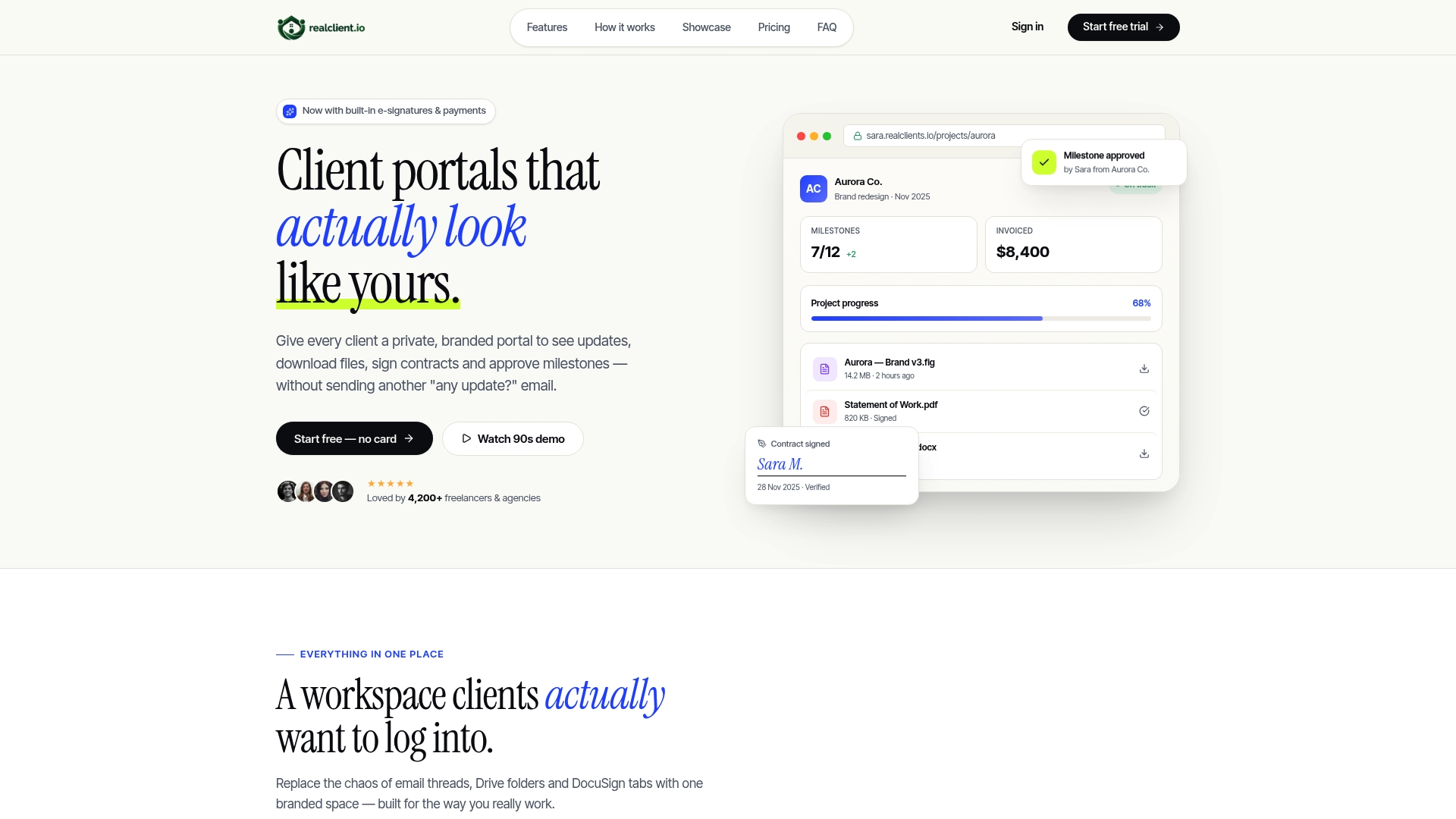
That matters most for the overage and rollover mechanics covered above: Realclient's usage dashboards let you show a client exactly where their hours stand before a dispute starts, not after. E-signatures and Stripe or PayPal payment processing are built into the same portal, so the 30-day notice period and prepaid-refund language in your contract aren't just sitting in a PDF nobody checks. If your current setup for recurring invoices still means logging into three separate tools every billing cycle, start a free trial and see Realclient's plans built specifically for freelancers running ongoing client work.
Sources
For legal grounding, the American Bar Association's retainer guidance covers required clauses and standard notice periods, while Cornell Law's Legal Information Institute explains the distinctions between retainer types and refundability. For pricing context, Investopedia's retainer fee overview explains why fees vary by market and expertise. For a ready-to-edit document, ContractDraft's retainer template offers copy-paste fields you can adapt to your own service model.
- Lawyer retainers (American Bar Association, 2025)
- Retainer agreement (Legal Information Institute, Cornell Law)
- Retainer fee (Investopedia, 2012)
- Free retainer agreement template (ContractDraft, reviewed June 2026)