
For consumer checkout, use a credit card. For recurring billing and large B2B invoices, use ACH. That's the short answer, and the math behind it is straightforward.
Credit cards authorize in seconds and convert well at checkout, but they cost you 1.5%–3.5% per transaction in interchange, assessments, and processor markup. ACH typically runs $0.20–$1.50 flat per transfer, settles in 1–3 business days under Nacha rules (most settle in one business day or less, but ACH Direct Debit can take up to 4 business days for acknowledgment), and carries no card-network chargeback exposure. The tradeoff is speed and guarantee: cards authorize instantly and funds are effectively guaranteed at the point of sale, while ACH is asynchronous and can be returned. PCI-DSS compliance adds another layer of obligation for card acceptance that ACH simply doesn't carry. Realclient processes invoicing and payments through client portals, and the pattern holds across the businesses using the platform.
Quick use-case verdict:
- Consumer retail or online checkout: Use credit card. Instant authorization, familiar UX, and high conversion rates justify the cost.
- Recurring subscriptions or retainers: Use ACH. Lower fees compound fast, and bank account details outlast card expiration cycles.
- Large B2B invoices ($1,000+): Use ACH. The fee savings on a single $10,000 invoice can exceed $200 compared to card processing.
Table of Contents
- How does ACH work, and what are ACH credit and ACH debit?
- How do credit card transactions actually work?
- ACH vs credit card: side-by-side comparison
- What do ACH and credit card fees actually cost you?
- How do settlement timing and cash flow differ between ACH and cards?
- How do chargebacks and ACH returns compare for merchant risk?
- How should your SMB decide which payment rail to use?
- How does a client portal reduce payment friction and speed up collections?
- Key Takeaways
- The payment rail choice most SMBs get wrong
- Realclient makes it easier to collect on both rails
- Authoritative references for deeper reading
How does ACH work, and what are ACH credit and ACH debit?
ACH stands for Automated Clearing House, the electronic network that moves money between U.S. bank accounts. Nacha governs the rules, standards, and operating procedures for every ACH transaction in the country. Think of Nacha as the rulebook and the ACH operators (the Federal Reserve's FedACH and The Clearing House's EPN) as the infrastructure that actually routes the files.

Every ACH transaction involves five actors: the originator (the business or person initiating the payment), the Originating Depository Financial Institution (ODFI, typically the originator's bank), the ACH operator, the Receiving Depository Financial Institution (RDFI, the recipient's bank), and the receiver (the account holder receiving or sending funds).
ACH credit vs ACH debit comes down to who pushes the money. In an ACH credit, the payer's bank pushes funds to the recipient — a payroll direct deposit is the classic example. In an ACH debit, the payee's bank pulls funds from the payer's account — a recurring subscription charge or a vendor payment you authorize works this way. For most SMBs collecting payments, ACH debit is the relevant flow.
Settlement windows and return rules
| ACH Type | Typical Settlement | Notes |
|---|---|---|
| Standard ACH | 1–3 business days (significant majority in 1 day or less) | Significant majority settle in one business day or less |
| Same-Day ACH | Same business day | Available for eligible transactions; per-item fee applies |
| ACH Direct Debit | Up to 4 business days | Stripe notes acknowledgement can take up to 4 business days |
Returns are the ACH equivalent of a dispute. Common return codes include R01 (insufficient funds), R02 (account closed), R10 (unauthorized debit), and R29 (corporate customer advises not authorized). Nacha sets return windows: most consumer returns must be submitted within 60 days of the settlement date for unauthorized transactions, and within 2 business days for administrative reasons. Merchants bear the cost of returned items and any associated fees.
Same-Day ACH handles most standard business payments and has a per-transaction dollar limit set by Nacha. When you need instant confirmation rather than same-day settlement, Instant Bank Payments (via rails like FedNow or RTP through The Clearing House) are an alternative worth evaluating, though adoption across financial institutions is still expanding.
How do credit card transactions actually work?
A credit card transaction moves through four stages: authorization, clearing, settlement, and potential dispute. The card networks — Visa, Mastercard, American Express, and Discover — set the rules and fees for each stage.
Authorization happens in seconds. When a customer swipes or enters card details, your processor sends a request to the card network, which routes it to the issuing bank. The issuer checks available credit and returns an approval or decline. At this point, no money has moved — the issuing bank has only placed a hold.

Clearing and settlement follow, typically within one to two business days. The processor batches authorized transactions and submits them to the card networks, which settle with the issuing banks and credit your merchant account. Cards provide near-instant authorization and a de facto guarantee of funds at purchase, but the actual deposit to your account arrives later.
The card fee stack
Card costs are layered, and understanding each layer helps you negotiate:
- Interchange: Paid to the card-issuing bank. This is the largest component and varies by card type, transaction type (card-present vs card-not-present), and merchant category code (MCC). Card-not-present (CNP) transactions, which cover most online sales, carry higher interchange than in-person swipes.
- Assessments: Paid to the card network (Visa, Mastercard, etc.). These are smaller, typically a fraction of a percent.
- Processor markup: What your payment processor charges on top. This is the negotiable part.
The combined effective rate for a typical retail CNP transaction is generally around the low single-digit percentages, with premium and international cards pushing rates higher.
Chargebacks are the card network's consumer dispute mechanism. A customer contacts their issuing bank, claims a problem with a charge, and the bank initiates a reversal. The merchant then has a window — typically 20–45 days depending on the network — to respond with evidence. If the merchant loses, they forfeit the transaction amount plus a chargeback fee (often $15–$50 per incident). High chargeback ratios trigger monitoring programs and can result in account termination. Visa's VAMP program now counts both fraud and disputes together when measuring merchant risk, which raises the stakes for businesses with even moderate dispute rates.
PCI-DSS (Payment Card Industry Data Security Standard) compliance is mandatory for any business that stores, processes, or transmits cardholder data. The level of compliance required scales with transaction volume, but every card-accepting merchant has obligations.
ACH vs credit card: side-by-side comparison
| Dimension | ACH | Credit Card |
|---|---|---|
| Typical fees | $0.20–$1.50 flat or capped % | 1.5%–3.5% (interchange + assessments + markup) |
| Settlement timing | 1–3 business days (same-day available) | Authorization instant; funds 1–2 business days |
| Dispute process | Nacha return rules; narrower consumer window | Card-network chargebacks; broader consumer rights |
| Merchant liability | Lower chargeback exposure; return risk exists | Higher chargeback risk; network monitoring applies |
| Best use cases | Recurring billing, B2B invoices, large payments | Consumer checkout, one-time retail, high-conversion flows |
| Integration & UX | Bank verification required; instant verification available | Card form, tokenization, one-click checkout |
| Transaction limits | No network-imposed cap for standard ACH | Varies by card limit and processor settings |
Worked examples: where the math gets real
Example A — $50 online retail sale: At 2.7% card processing, you pay $1.35 in fees. With ACH at a $0.50 flat fee, you pay $0.50. The $0.85 difference per transaction seems small, but at 500 transactions per month, that's $425 in monthly savings. The catch: consumer checkout conversion typically drops when you remove the card option, so the math has to account for lost sales too.
Example B — $10,000 B2B invoice: At 2.7% card processing, you pay $270 in fees. With ACH at $1.00 flat, you pay $1.00. The $269 difference on a single invoice is hard to argue against. B2B clients generally accept ACH without friction, and the payment is typically pre-authorized through a contract or purchase order, reducing dispute risk further.
The crossover point where ACH becomes cheaper than cards on a percentage basis occurs at relatively low transaction amounts given typical flat ACH rates. Above that threshold, ACH almost always wins on cost.
What do ACH and credit card fees actually cost you?
Card fees have three layers, and only one of them is negotiable. Interchange goes to the issuing bank and is set by the card networks — you cannot negotiate it directly. Assessments go to the card network and are similarly fixed. Processor markup is where you have leverage.
Factors that push card fees higher:
- Card-not-present transactions: Online and phone orders carry higher interchange than in-person swipes because fraud risk is higher.
- Premium card types: Corporate, rewards, and travel cards carry elevated interchange rates that your processor passes through.
- High-risk MCC codes: Certain merchant categories (travel, software, coaching) face higher base rates.
- International cards: Cross-border transactions add network fees on top of standard interchange.
ACH pricing models vary by processor. Flat per-transaction fees typically apply for high-volume, lower-value transactions, while capped-percent models favor larger transactions. Same-Day ACH usually carries a small premium over standard ACH.
Pro Tip: When comparing processor quotes, ask for the effective rate on your actual transaction mix — not the advertised rate on a hypothetical transaction. A processor quoting 2.5% on a standard Visa debit card may charge 3.2% on the corporate Amex cards your B2B clients actually use. Request a fee schedule that breaks out interchange pass-through separately from markup.
For large-ticket invoices, ACH for small business billing is the clearest cost win. A freelancer or agency billing $5,000 retainers monthly saves roughly $130–$165 per invoice compared to card processing at 2.7%–3.3%. Over 12 months with five clients, that's $7,800–$9,900 in recovered margin.
Checklist: questions to ask any processor before signing:
- What is the interchange pass-through model, and can I see a sample statement?
- What are your fees for Same-Day ACH vs standard ACH?
- How do you handle ACH returns — is there a per-return fee?
- What is your chargeback fee, and at what ratio do you place accounts in monitoring?
- Do you support instant bank verification (Plaid, Financial Connections)?
- What are your rolling reserve or hold policies for new accounts?
Surcharging (passing card fees to customers) is legal in most U.S. states but regulated — check your state's rules and card-network requirements before implementing. A simpler approach for many SMBs: offer a small ACH discount (e.g., 1.5% off the invoice total) rather than a card surcharge. The framing matters to customers, and the economics are similar.
How do settlement timing and cash flow differ between ACH and cards?
The authorization-to-settlement gap is where cash-flow surprises hide. A card sale that authorizes at 9 AM on Monday may not deposit to your merchant account until Wednesday. An ACH debit initiated Monday morning typically settles Tuesday or Wednesday — but unlike a card, it can still return for up to 60 days on an unauthorized-debit claim.
Card authorization is near-instant, which creates a false sense of certainty. The funds aren't in your account yet, and a chargeback filed weeks later can reverse a transaction you've already spent. ACH settlement is slower to start but, once past the return window, is more final.
For practical cash-flow management:
- Same-Day ACH: — Available for eligible transactions and useful when you need faster confirmation without the cost of a wire transfer. FedNow and RTP (Real-Time Payments via The Clearing House) offer near-instant settlement for participating banks, though not every financial institution supports them yet.
Pro Tip: If you accept both payment rails, keep two separate line items in your cash-flow forecast: "card revenue pending" and "ACH revenue pending." Treat card revenue as available in 1–2 days but flag it as chargeback-exposed for 90–120 days. Treat ACH as available in 2–3 days and flag it as return-exposed for 60 days. This two-line model prevents you from double-counting available cash during reconciliation.
For freelancers and agencies managing instant payment tools, understanding these timing windows is the difference between confident cash-flow forecasting and scrambling to cover a gap.
How do chargebacks and ACH returns compare for merchant risk?
The dispute ecosystems for cards and ACH are structurally different, and that difference shapes your risk exposure in ways that aren't obvious until you've dealt with both.
Card chargebacks are initiated by the cardholder through their issuing bank. The bank provisionally reverses the charge, and the merchant must respond within the network's deadline (typically 20–45 days). Common reasons include "item not received," "not as described," and "unauthorized transaction." Merchants who win disputes get the funds back; merchants who lose pay the chargeback fee on top of the transaction amount. Card networks monitor chargeback ratios — Visa's standard threshold is 0.9% of transactions, and Mastercard's is 1.0%. Exceeding these thresholds triggers monitoring programs with escalating fees and, eventually, account termination.
ACH returns follow Nacha's return rules and are narrower in scope. Most administrative returns (wrong account number, account closed) must be submitted within 2 business days. Unauthorized-debit claims from consumers have a 60-day return window from the settlement date. Unauthorized claims from businesses are shorter — typically 2 business days. The merchant liability profile is different: ACH returns don't carry the same network-monitoring framework as card chargebacks, but repeated unauthorized-debit returns can still trigger processor scrutiny.
Fraud risk profiles by rail:
- Card fraud: Stolen card numbers, CNP fraud (fake card details used online), and account takeover are the primary vectors. Tokenization, CVV verification, and address verification (AVS) are standard mitigations. 3D Secure (Visa Secure, Mastercard Identity Check) adds an authentication layer for online transactions.
- ACH fraud: Unauthorized debits (someone initiates a pull without proper authorization), synthetic account fraud (fake bank account details), and business email compromise (BEC) leading to fraudulent payment redirects. Mitigations include instant bank verification via services like Plaid, mandate management with signed authorization records, and micro-deposit verification for new accounts.
Practical dispute timelines:
| Event | Card | ACH |
|---|---|---|
| Dispute initiated | Cardholder contacts issuer | Account holder contacts RDFI |
| Merchant notified | Within a few days | Typically 1–2 business days |
| Merchant response window | 20–45 days (network-dependent) | 2–60 days (reason-code dependent) |
| Final resolution | 60 days | 5–10 business days for most returns |
For SMBs, the practical takeaway is that card chargebacks are more frequent and more costly to fight, while ACH returns are less common but can still sting on large transactions. Requiring e-signature authorization for ACH mandates is one of the most effective ways to reduce unauthorized-debit return risk.
How should your SMB decide which payment rail to use?
The right answer depends on your business model, average transaction size, and customer type. Here's a practical framework.
Questions to ask any payments provider before committing:
- What are your exact fees for card-present, card-not-present, and ACH transactions?
- Do you support Same-Day ACH, and what is the per-item premium?
- How do you handle ACH returns — is there a per-return fee, and do you flag accounts after a threshold?
- What instant bank verification options do you support (Plaid, Financial Connections, micro-deposits)?
- What is your chargeback fee, and at what ratio do you escalate to monitoring?
- Do you offer rolling reserves, and under what conditions?
- What integrations and SDKs do you support for embedding payments in a client portal or billing system?
Recommended payment patterns by business profile:
-
Service freelancers and consultants: Prioritize ACH for invoices above $500. The fee savings are immediate and clients in professional services rarely push back on bank transfers. Keep a card option available for smaller, one-off payments where conversion matters. Use a client payment request workflow that makes ACH the default and card the secondary option.
-
Subscription and SaaS businesses: ACH is the stronger long-term choice for recurring billing. Bank account credentials don't expire the way card numbers do, which means fewer failed payments and lower involuntary churn. ACH reduces failed recurring payments compared with cards for subscription billing, and modern "Pay by Bank" integrations using instant bank verification make the signup flow nearly as smooth as entering a card number.
-
B2B and wholesale sellers (large invoices): ACH is almost always the right call. A $25,000 invoice processed by card at 2.7% costs $675 in fees. Via ACH, it costs under $2.00. Clients in B2B contexts expect bank transfers and often prefer them. Combine ACH with a CRM and payment processing setup that automates reminders and reconciliation.
For UX, the gap between card and ACH has narrowed considerably. Modern instant bank verification services connect to a customer's bank account in seconds, eliminating the multi-day micro-deposit wait that used to make ACH onboarding painful. Plaid's Auth product and Stripe Financial Connections both support real-time account verification, making ACH as fast to set up as a card form for most users.
A small ACH discount is often enough to shift B2B clients from card to bank transfer without friction. Run it as a 60-day pilot, track the fee savings, and measure whether the discount cost less than the card fees you avoided.
How does a client portal reduce payment friction and speed up collections?
A branded client portal centralizes the entire payment workflow: invoice delivery, bank account authentication, mandate storage, and reconciliation all happen in one place. That consolidation removes the friction points where payments stall — a client who has to switch between email, a PDF invoice, a separate payment link, and a bank portal will delay. A client who sees the invoice, signs the mandate, and authorizes the ACH debit in a single session pays faster.
Realclient's portal supports both card payments (via Stripe) and bank debits, with instant bank verification built into the onboarding flow. When a client connects their bank account through the portal, the verified account details are stored for future recurring charges — no re-entry, no expired card failures, no manual follow-up.
Over $48 million has been invoiced through Realclient portals. That volume reflects a consistent pattern: when invoicing, authorization, and payment happen inside a single branded workspace, collection cycles shorten and failed-payment rates drop.
The practical impact on ACH adoption is real. Clients who might hesitate to enter bank details on a standalone payment link are more comfortable doing it inside a portal they've already used to review project files and sign contracts. The trust is already established. Adding instant bank verification via Plaid or Stripe Financial Connections means the verification step takes seconds rather than days, removing the last significant UX barrier to ACH adoption for recurring billing.
For involuntary churn specifically, storing verified bank account mandates in the portal means a failed payment triggers an automatic retry rather than a manual chase. That single workflow change can recover a meaningful share of revenue that would otherwise slip through the cracks.
Key Takeaways
ACH wins on cost for recurring billing and large B2B invoices, while credit cards remain the right choice for consumer checkout where conversion and instant authorization matter.
| Point | Details |
|---|---|
| Use ACH for large invoices | ACH fees run $0.20–$1.50 flat vs 1.5%–3.5% for cards; savings compound fast above $500 per transaction. |
| Cards win at consumer checkout | Near-instant authorization and familiar UX justify the higher cost for one-time retail and online sales. |
| ACH reduces subscription churn | Bank account credentials don't expire like card numbers, cutting failed recurring payments over time. |
| Dispute profiles differ sharply | Card chargebacks are network-mediated and common; ACH returns are narrower but can expose you for up to 60 days on unauthorized claims. |
| Realclient centralizes both rails | Realclient's portal supports card and ACH payments with instant bank verification, reducing collection friction and failed-payment rates. |
The payment rail choice most SMBs get wrong
Most small businesses default to cards for everything because setup is easy and customers expect it. That's a reasonable starting point, but it's expensive to maintain as a permanent strategy.
The businesses that optimize payment costs don't eliminate cards. They route intelligently: cards for checkout, ACH for everything recurring or high-value. The fee math is not subtle. A design agency billing ten clients at $3,000 per month pays roughly $810–$990 per month in card processing fees at 2.7%–3.3%. Switching those same invoices to ACH at $1.00 per transaction costs $10. The $800–$980 monthly difference is real margin, not a rounding error.
What most guides miss is the churn angle. Subscription businesses that rely on saved cards face a silent revenue leak every time a card expires or gets reissued. ACH eliminates that leak. The upfront friction of collecting bank details is a one-time cost; the benefit compounds every billing cycle.
The practical move is to start with your largest recurring invoices. Run the fee math on your actual average ticket, enable ACH for invoices above your breakeven point, and add instant bank verification so the client experience stays clean. You don't need to overhaul your entire payment stack at once. One workflow change on your highest-value invoices will show the impact within 90 days.
Realclient makes it easier to collect on both rails
If you're billing clients through scattered emails and standalone payment links, you're leaving money on the table — not just in fees, but in collection speed. Realclient gives you a branded client portal where invoicing, e-signatures, and payment processing (cards and ACH bank debits via Stripe) live in one place.
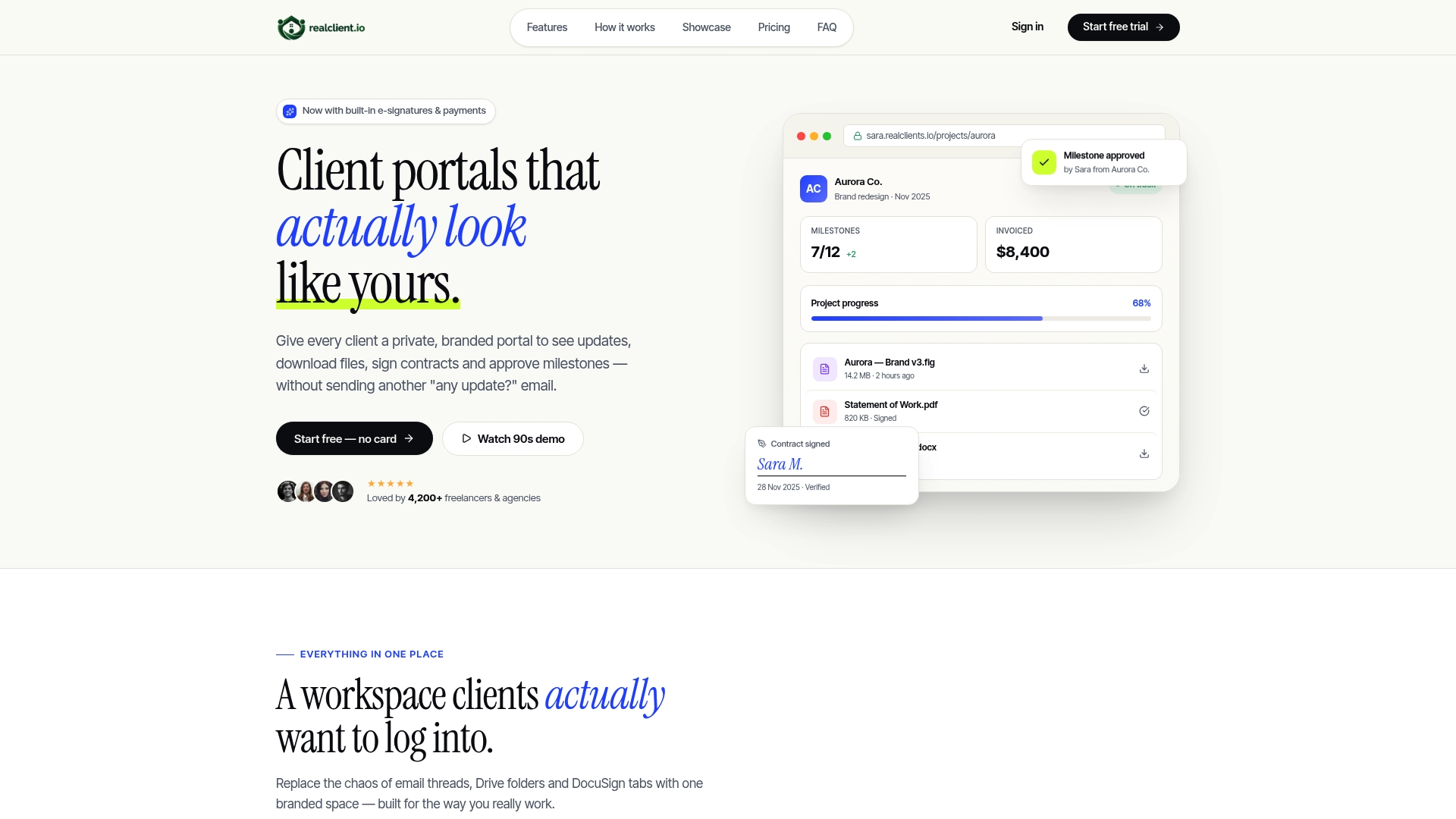
Your clients sign contracts, review project updates, and pay invoices without leaving the portal. Instant bank verification means ACH setup takes seconds, not days. Stored mandates mean recurring billing runs automatically, with no manual follow-up on failed payments. For finance teams evaluating bank-grade security and PCI compliance, Realclient's infrastructure is built to meet those standards.
The result: shorter collection cycles, lower processing fees on high-value invoices, and fewer involuntary payment failures on recurring billing. See Realclient's pricing plans to find the tier that fits your client volume, or explore the full portal to see how it handles payments end-to-end.
Authoritative references for deeper reading
| Source | What it covers | Why it's useful |
|---|---|---|
| Nacha: ACH Network Rules and How ACH Works | Official ACH operating rules, return codes, and settlement standards | Primary source for ACH compliance and mandate requirements |
| Nacha: Settlement Timing Data | Data on ACH settlement speed across the network | Backs settlement timing claims in this article |
| Stripe: ACH vs Card Transactions | Processor-level comparison of ACH and card mechanics | Practical integration and operational guidance |
| Stripe: ACH Direct Debit Documentation | Technical specs for ACH Direct Debit, including timing and verification | Essential for developers and finance teams building ACH flows |
| Plaid: Payment Processing Costs | Fee benchmarks for ACH and card processing | Source for fee range data used in this article |
| Plaid: ACH vs Credit Cards for Business | Business case for ACH adoption, including subscription billing benefits | Supports recurring billing and churn reduction arguments |
| Plaid: Auth Product | Instant bank verification API for ACH onboarding | Best practice reference for reducing ACH friction |
| Visa VAMP Fact Sheet | Visa's fraud and dispute measurement program | Relevant for merchants monitoring chargeback ratios |
| The Clearing House: RTP Network | Real-Time Payments infrastructure in the U.S. | Context for instant payment rail alternatives to ACH |
| Federal Reserve: FedNow Service | Federal Reserve's instant payment service | Background on the U.S. instant payment infrastructure |