
A late fee holds up only when the customer agreed to it in writing before the invoice came due, the amount was clear and reasonable, and you applied it the same way every time. Everything else, the exact wording, the dollar figure, the grace period, only matters once those three conditions are locked in. Get the agreement right first, then use the templates and automation steps below to make it stick.
TL;DR:
- A late fee must be agreed upon in writing before the invoice due date, with clear, specific terms regarding amount, timing, and calculation method.
- Enforceability relies on consistent application, proper documentation, and transparency at multiple touchpoints, including contracts, invoices, and reminders.
- Flat fees are suitable for small to mid-size invoices, while percentage-based fees better scale for larger, variable balances, and combined structures can incentivize early payment.
- State laws and federal regulations require late fees to be reasonable and proportionate to actual costs, with caps or restrictions in certain jurisdictions or on card transactions.
- Avoid charging late fees on first-time delinquents, small balances, or disputed payments by implementing a short grace period and documenting any waivers.
Table of Contents
- What Makes a Late Fee Policy Enforceable?
- Which Type of Late Fee Fits Your Business?
- Where Should Late Fee Wording Actually Appear?
- How Do You Apply Late Fees Consistently Without Creating Disputes?
- What Legal Limits Should You Check Before Setting a Fee?
- When Should You Skip the Late Fee Entirely?
- Copy-Paste Late Fee Templates You Can Use Today
- Are Late Fees a Penalty or a Relationship Tool?
- Enforce Your Late Fee Policy Without Chasing Every Invoice by Hand
- Where to Verify These Late Fee Rules Yourself
- Sources
What Makes a Late Fee Policy Enforceable?
A late fee is not a formality you tack onto an overdue invoice. It is a contractual claim, and like any contractual claim, it has to survive scrutiny if a client pushes back or a court gets involved. Five requirements separate a late fee that holds up from one that gets waived the moment someone complains.
Advance agreement in writing. You cannot introduce a late fee after the invoice is already overdue. The customer has to see it, and in some demonstrable way accept it, before the work starts or the first invoice goes out. That agreement can take several forms:
- A signed service contract or terms of service with the late fee clause spelled out.
- A checkbox at checkout or booking that the client actively selects.
- An e-signature on a proposal or engagement letter that references the fee schedule.
Retroactive fees, ones added to an invoice after the due date has already passed without prior notice, are close to impossible to enforce. One widely cited guide on invoice late payment fee wording puts it bluntly: fees not on the original contract or invoice, and not clearly disclosed beforehand, do not hold up.
Clarity. Vague language like "late fees may apply" invites disputes. State the exact dollar amount or percentage, the date the clock starts ticking, and whether there is a grace period before the fee kicks in. If a client can argue they didn't know how the number was calculated, you've already lost the argument.
Reasonableness. Courts and regulators look at whether a fee reflects real administrative or financing cost, not whether it punishes the client for being late. A $500 flat fee on a $200 invoice will draw a challenge fast. Tie your number to something defensible: the cost of chasing payment, the interest you'd pay on a short-term loan, or industry norms.
Lawfulness. Some states cap fees on certain transaction types, and if your business touches credit-card processing, federal rules come into play. The Consumer Financial Protection Bureau's revised Regulation Z rulemaking reinforces that late fees tied to card accounts must stay reasonable and proportional to the issuer's actual costs. Even if that rule targets card issuers directly, it signals where regulatory scrutiny is heading.
Consistency and documentation. Charge the fee every time the condition is met, or don't charge it at all for that category of client. Selective enforcement, waiving it for friends and applying it to strangers, is one of the fastest ways to lose a dispute, because it makes the fee look punitive rather than procedural.
Pro Tip: Keep a simple log of every late fee you've waived and why. If a client ever argues you're enforcing unevenly, that log is your best defense, and it takes thirty seconds to update after each decision.
Which Type of Late Fee Fits Your Business?
Three structures cover almost every situation you'll encounter, and picking the right one depends on invoice size, client relationship, and how much administrative friction you're willing to tolerate.
-
Flat fee. A fixed dollar amount, commonly $25 to $50 for small to mid-size invoices, charged once the due date passes. Flat fees are easy to communicate and easy for clients to budget around, which makes them a good fit for recurring service invoices where the amount owed doesn't swing much month to month. The downside: a flat fee on a $10,000 invoice barely registers, while the same fee on a $150 invoice feels excessive.
-
Percentage or interest-based fee. Typically 1% to 2% of the outstanding balance per month, applied for each month or partial month the invoice remains unpaid. A $5,000 invoice at 1.5% monthly accrues $75 in the first month. This scales naturally with invoice size, which makes it the better choice for larger contracts, freelance retainers, or agency work where balances vary widely.
-
Combined or tiered structure. A flat fee for the first missed deadline, then a monthly percentage if the balance stays unpaid past a second threshold. This rewards quick correction while still compounding pressure on chronic late payers.
One legal trap deserves its own line: compound interest. If your clause charges interest on an already-overdue balance that includes previously accrued fees, you may be charging interest on interest without meaning to. Some states restrict or ban this outright. Stick to simple interest on the original principal unless your contract explicitly and clearly states otherwise, and even then, verify it against your state's statute first.
For a small studio invoicing a handful of long-term clients, a modest flat fee usually preserves the relationship better than a percentage model. For agencies managing dozens of contracts with fluctuating balances, percentage-based fees scale more fairly and protect cash flow on the invoices that matter most.
Where Should Late Fee Wording Actually Appear?
A late fee clause buried in paragraph 14 of a contract nobody reread does you no good if the client never noticed it. Enforceability depends on visibility at four separate touchpoints, not just one.
The contract or terms of service. This is the foundational agreement. Spell out the fee type, the amount or rate, the grace period, and the date the clock starts. This is also where you capture the client's active acceptance, whether that's a signature, an initialed clause, or a click-to-accept checkbox during onboarding.
The invoice itself, usually the footer. Every invoice you send should restate the fee, even briefly. A one-line footer works: "Payment due within 15 days.
Checkout or booking confirmation. If clients pay through an online form or book a service digitally, the late fee notice belongs right there, next to the total, not buried in a linked terms page they'll never open.
Overdue reminders. Once a payment is late, your reminder email should restate the fee that's about to apply, or already has, along with the exact dollar figure now owed.
A clause has five parts worth including every time:
- Payment term: when payment is due (net 15, net 30, due on receipt).
- Grace period: how many days after the due date before the fee triggers, if any.
- Fee type and amount: flat dollar figure or percentage rate.
- Calculation method: simple interest, applied monthly, based on the outstanding principal.
- Collections language: what happens if the balance goes unresolved past a defined point (referral to collections, service suspension, legal action).
For subscription or recurring billing, the same rules apply, but the trigger point shifts. Each billing cycle resets the due date, so your recurring invoice terms need to state clearly whether the late fee applies per cycle or accrues across missed cycles. Auto-renewal contracts should also disclose the late fee schedule at the point of renewal, not just at initial signup, since courts have increasingly scrutinized auto-renewal disclosures broadly.
| Placement | What it should say | Why it matters |
|---|---|---|
| Contract / terms of service | Full clause: rate, grace period, calculation method, collections language | Establishes advance agreement and captures acceptance |
| Invoice footer | Short restated line with amount and trigger date | Reinforces awareness at every billing cycle |
| Checkout / booking | Fee notice next to total before payment | Prevents "I didn't see it" disputes |
| Overdue reminder | Restated fee plus current amount owed | Documents notice before or as the fee applies |
Good payment terms language makes all four placements consistent, so a client sees the same number and the same rules no matter where they encounter them.
How Do You Apply Late Fees Consistently Without Creating Disputes?
Clause wording gets most of the attention, but inconsistent application is what actually sinks late fee policies in practice. If you charge the fee to one client and quietly skip it for another with the same terms, you've built a pattern a lawyer can use against you.
A workable checklist looks like this:
- Capture signed terms at onboarding, before any invoice goes out, not after the first payment is late.
- Include the fee on every invoice footer, without exception, so there's no client who genuinely never saw it.
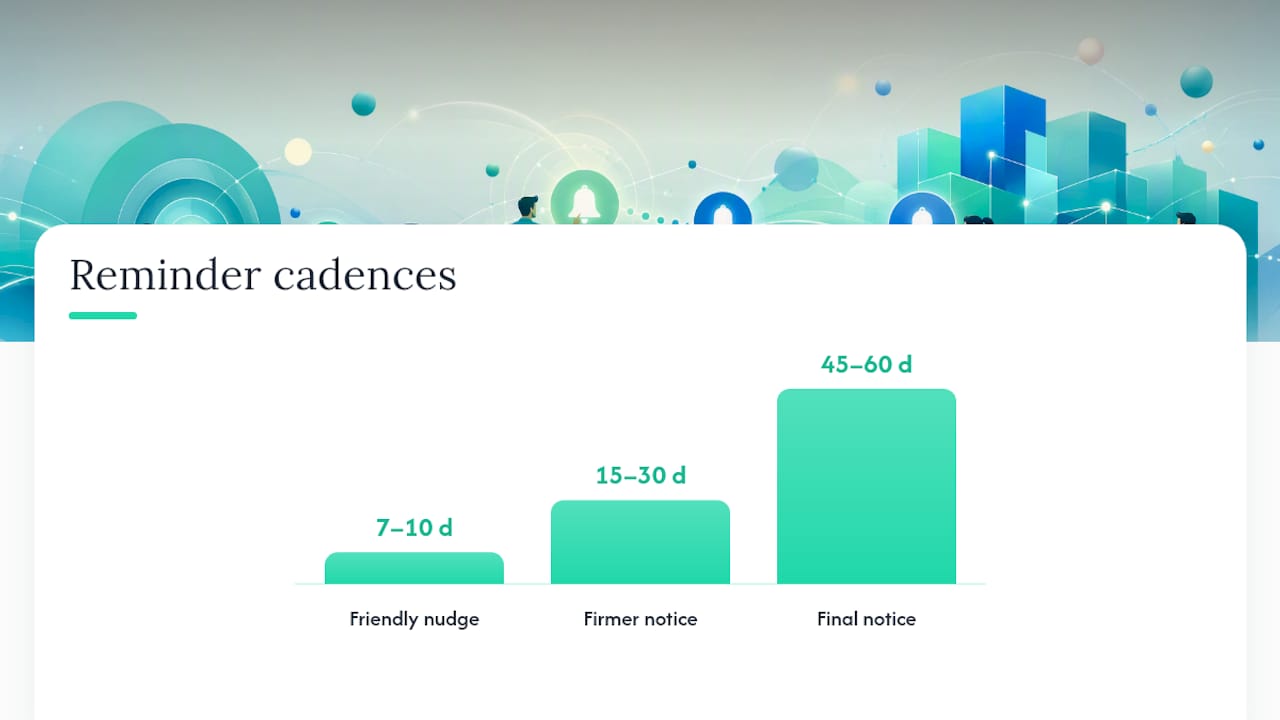
- Set automated reminders on a fixed cadence, commonly a friendly nudge at 7 to 10 days, a firmer notice at 15 to 30, and a final notice at 45 to 60 days past due.
- Auto-apply the fee once the trigger date passes, rather than deciding case by case, which is where inconsistency creeps in.
- Keep an immutable audit trail: timestamped acceptance, invoice history, and every reminder sent.
Integrated e-signatures and payment tools close most of the gap between a clause that sounds good and one that actually holds up. When a client's acceptance is a timestamped e-signature or a logged checkbox rather than a verbal agreement, you have something concrete to point to if a dispute ever escalates. That combination, a signed acceptance event plus an unbroken invoice and payment record, is consistently cited as the strongest evidence businesses can produce in a late fee dispute.
Three metrics are worth tracking once your process is running: days sales outstanding (how long it takes to get paid on average), your fee recovery rate (what percentage of applied fees actually get paid rather than waived after pushback), and your dispute rate (how often a client contests the charge at all). A rising dispute rate usually points to unclear wording or inconsistent timing, not an unreasonable fee amount.
Realclient's own portal data reflects what consistent, automated enforcement looks like at scale: freelancers and agencies using integrated invoicing and e-signature capture through the platform have processed over $48 million in client payments, with acceptance and payment history logged automatically rather than tracked across scattered email threads.
Pro Tip: If you're not ready to automate reminders, at minimum put a recurring calendar reminder on your own schedule to check overdue invoices weekly. Manual tracking beats no tracking, but it's the first thing that breaks down once you're juggling more than a handful of active clients.
What Legal Limits Should You Check Before Setting a Fee?
State law is the wildcard in every late fee policy, and it varies more than most business owners expect. Many states don't set a specific numeric cap on commercial late fees at all, but they do require that the fee be reasonable in relation to actual cost, which means an aggressive flat fee or double-digit percentage rate can still get struck down even without a named statutory limit.
Where federal rules do bite is on the card-processing side. The CFPB's Regulation Z amendments revised safe-harbor dollar amounts for credit-card late fees and reinforced that fees must be proportional to the issuer's actual collection costs, not set as a blanket penalty. If any part of your billing routes through card-based financing or installment plans, that rule is directly relevant, not just a background consideration.
For a practical, non-exhaustive way to check where you stand:
- Search your state's statutes for "late fee," "finance charge," or "usury" alongside your business type (services, rental, retail).
- If you serve consumers directly rather than B2B clients, consult a lawyer before finalizing a percentage-based fee. Consumer protection rules are stricter than commercial ones almost everywhere.
- When in doubt, default conservative. A 1% monthly rate or a modest flat fee rarely triggers regulatory attention and still meaningfully improves collection timelines.
- Revisit your policy annually. State legislatures amend commercial finance rules more often than most business owners realize.
The IRS offers a useful, if unrelated, reference point for how penalty structures are typically communicated: its own failure-to-pay penalty accrues at a fixed 0.5% per month up to a defined cap, with an exact start date and calculation method spelled out in the rule itself. That level of specificity, not the rate, is the model worth copying.
When Should You Skip the Late Fee Entirely?
Charging a fee every single time a payment slips isn't always the right call, even when your contract permits it. A first-time offender on an otherwise clean payment history, a small balance where the fee costs more in goodwill than it recovers in revenue, or a payment stuck in an active billing dispute are all situations where enforcing the fee can do more damage than the late payment itself.
Better alternatives exist for most of these cases:
- Offer a short, clearly bounded grace period (3 to 5 days) before the fee triggers automatically.
- Set up a structured payment plan for clients facing genuine short-term cash issues.
- Pause future service delivery rather than charging a penalty, which protects your time without souring the relationship.
- Use a graduated reminder cadence, friendly first, firmer only if the balance stays open, before ever mentioning the fee.
Whenever you waive a fee, write down why. A one-line note in your records ("waived, first late payment, otherwise on-time client") protects you if a different client later questions why they were charged and someone else wasn't.
Copy-Paste Late Fee Templates You Can Use Today
Contract clause, flat fee: "Invoices unpaid 15 days past the due date incur a one-time late fee of $35."
Combined clause: "A $25 flat fee applies after 10 days past due."
Invoice footer: "Payment due within 15 days of invoice date. A late fee applies to balances outstanding after the due date. See contract for details."
Friendly reminder (pre-fee): "Just a quick note that your invoice is due in 3 days. Let us know if anything's holding up payment on your end."
Post-fee notice: "This invoice is now past due and a late fee has been applied per our agreement. The updated total is reflected above." For more phrasing options, see this guide on asking a client for payment professionally.
Are Late Fees a Penalty or a Relationship Tool?
Most business owners set a late fee to punish lateness. That's the wrong frame. The fee's real job is to change behavior before it becomes a habit, and the businesses that get the most out of their policy treat it as a nudge, not a punishment.
Consistency does more work than the number itself. A modest, reliably applied fee tends to shift payment timing faster than an aggressive one that gets waived half the time out of guilt. Start conservative, apply it every time, and adjust only after you've watched it run for a full billing cycle or two.
— Real
Enforce Your Late Fee Policy Without Chasing Every Invoice by Hand
Realclient turns your late fee policy from a clause clients might miss into a process that runs itself. Every contract gets signed, every invoice gets sent, and every reminder goes out on schedule, all logged in one branded portal instead of scattered across email threads and spreadsheets.
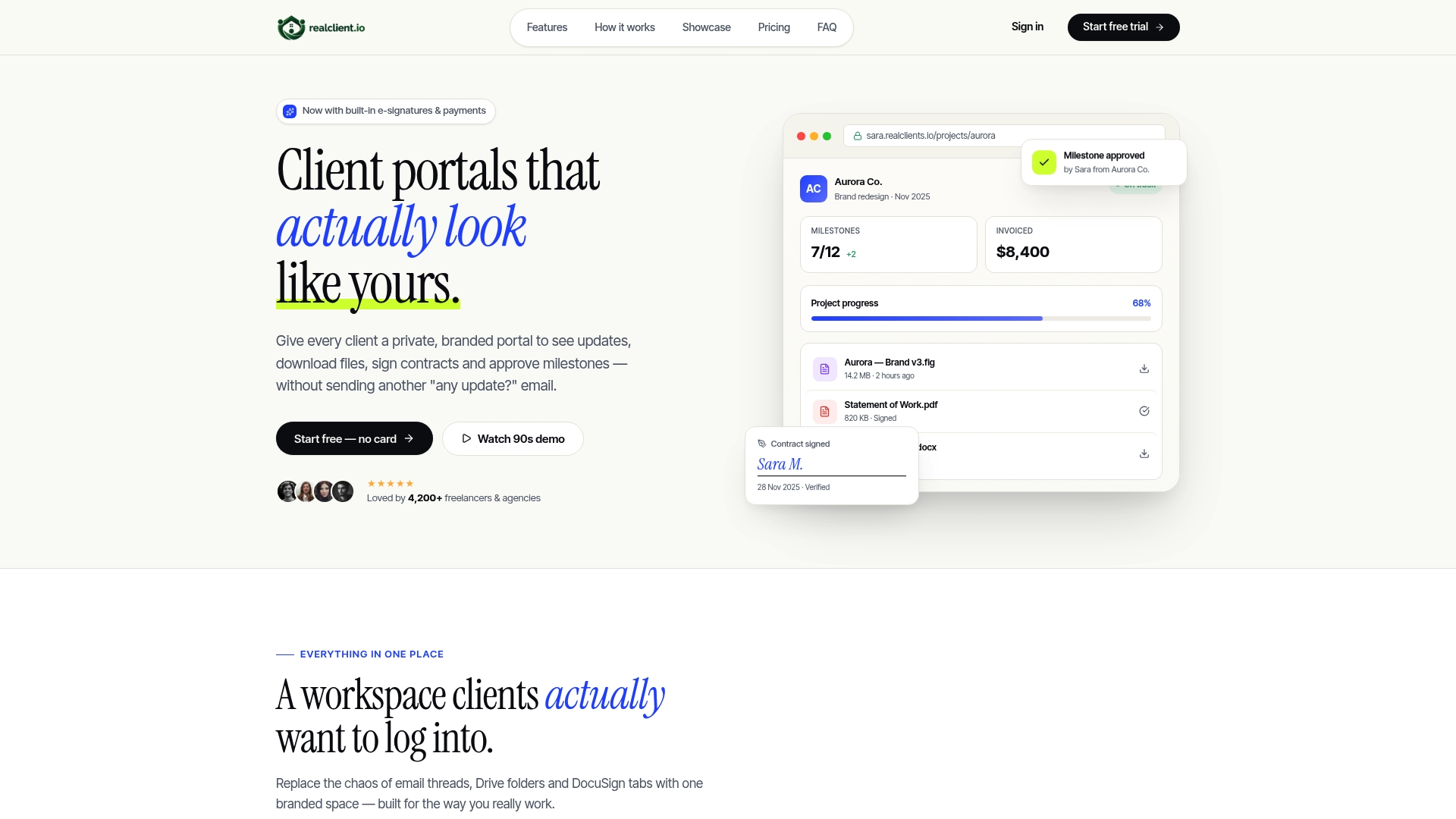
The portal captures e-signatures on your contract terms at onboarding, restates fee terms directly on invoices, and sends automated reminders on the cadence you set, so the acceptance and payment history you'd need in a dispute already exists before you ever need it. One-click Stripe and PayPal payments mean clients have fewer excuses for delay in the first place. Freelancers and agencies running their invoicing this way have processed over $48 million through Realclient portals, with every acceptance event and payment logged automatically. If you're rebuilding your client portal setup around a policy that actually holds up, start a free trial at Realclient and see your first automated reminder go out this week.
Where to Verify These Late Fee Rules Yourself
For the legal backbone of this guide, review the CFPB's Regulation Z final rule on card late fees and the IRS failure-to-pay penalty structure. For contract valuation context when late fees affect receivables, see Captyx's guide to selling a professional services business.
This article is general information, not a substitute for advice from a qualified lawyer. Consult a qualified legal professional about your own circumstances before acting on anything here.
Sources
- Federal Register: Consumer Financial Protection Bureau final rule amending Regulation Z (2024)
- Late Payment Fees: Protect Cash Flow Without Losing Customers
- Invoice Late Payment Fee Wording: Templates, Examples & Contract Clauses for Small Businesses
- IRS — Failure to pay penalty