
The most effective way to reduce scope creep is to treat every new request as a documented decision, not a favor. Tie each ask to a visible trade-off (extra time, extra budget, or dropped scope) and log it against a written baseline. Three levers make this work fast: a one-paragraph scope baseline with clear exclusions, a short change-request form, and scheduled scope reviews. What follows are the exact templates, decision flow, and warning signs to put this into practice this week.
TL;DR:
- Writing a clear scope baseline and explicitly listing exclusions helps prevent misunderstandings and disputes over project deliverables.
- Using a short change-request form and a designated decision maker makes requests traceable and easier to control.
- Tracking unapproved hours and small, informal requests allows early detection of scope creep before deadlines are missed.
- Establishing a disciplined, four-step decision flow for every request ensures scope changes are evaluated systematically and transparently.
- Implementing a client portal for requests, approvals, and billing creates a visible record that reinforces scope discipline and streamlines project management.
Table of Contents
- How to Reduce Scope Creep in Hours, Not Weeks
- What Is Scope Creep, Really?
- Why Scope Creep Happens (and How to Catch It Early)
- Building a Prevention System That Actually Sticks
- The Four-Step Decision Flow for Every New Request
- The Numbers That Tell You Creep Is Happening
- What to Do When Creep Has Already Taken Hold
- Turning Scope Control Into a Visible Record
- A Small Trade-Off Conversation That Saved a Project
- Why a Client Portal Makes Scope Control Easier to Enforce
- Sources
How to Reduce Scope Creep in Hours, Not Weeks
You don't need a new methodology to slow down scope creep. You need a handful of small, boring habits, applied consistently. Here's the shortlist to run through today.
- Write a one-paragraph scope baseline naming deliverables, timeline, and what's explicitly excluded.
- Name the change approver at kickoff, in writing, so nobody is guessing who says yes.
- Build a short change-request form and set a threshold for what counts as "minor."
- Start milestone scope reviews now, even informally, and keep a running scope log.
- Check team capacity before you approve anything, not after.
- Apply a simple heuristic, like two hours or $250, to separate trivial asks from real changes, then log even the trivial ones.
- Track every ad-hoc request in one place and set aside 15 minutes each week to clean it up.
- If scope has already drifted, stop and run an inventory of what's been added before agreeing to anything else.
None of these take more than an afternoon to set up. The hard part isn't the paperwork. It's the discipline to use it every time a client says "quick favor" instead of "change request."
Pro Tip: Keep a running "future phase" list for good ideas that don't fit the current scope. It lets you say "not now" without saying "no," and clients tend to respect that far more than a flat rejection.
What Is Scope Creep, Really?
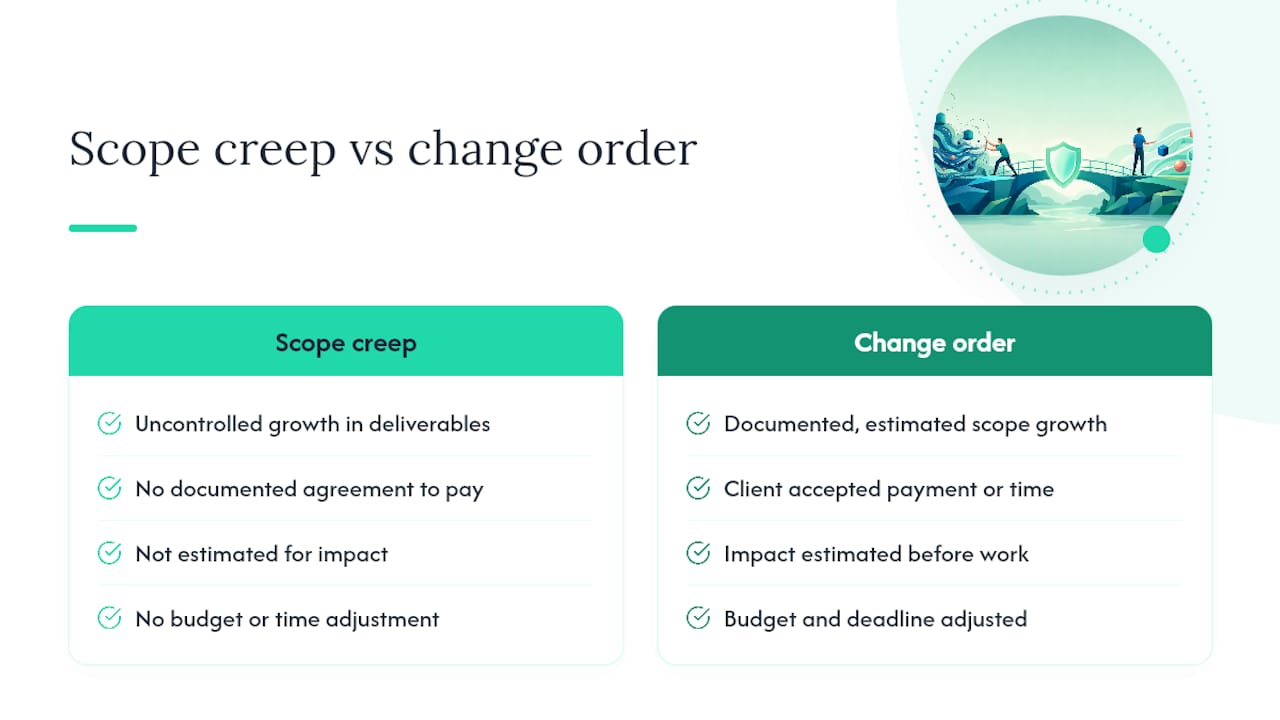
Scope creep is uncontrolled growth in a project's deliverables, work, or features without a matching adjustment to time, budget, or staffing. It usually arrives quietly: a client asks for "one small tweak," a teammate adds a feature nobody scoped, and three weeks later the project timeline makes no sense.
Contrast that with an approved change, sometimes called a change order. A change order is scope growth that has been documented, estimated, and accepted, with the budget or deadline adjusted to match. The work is the same kind of work. The difference is whether anyone agreed to pay for it in time or money.
This distinction isn't just semantic. It determines what you can invoice for, what you can defend in a client dispute, and who's accountable when a deadline slips. A lightweight change control process that captures the request, estimates its impact, and updates the baseline is what turns creep into a legitimate change order.
Why Scope Creep Happens (and How to Catch It Early)
Scope creep rarely comes from one dramatic request. It builds from small failures in how a project is defined and managed.
- Vague requirements or thin statements of work. If the SOW doesn't specify deliverables in detail, everyone fills the gaps with their own assumptions.
- Requests made over chat or email that skip the change process entirely. These feel harmless because they're informal, which is exactly the problem.
- Too many stakeholders with no clear approval owner. When five people can ask for changes and nobody has to say yes formally, requests multiply.
- No visibility into team capacity. Approving "just one more thing" is easy when you can't see that the team is already booked solid.
- Gold plating, where your own team adds polish or features nobody asked for, quietly expanding scope from the inside.
The early warning signs show up in the numbers before they show up in a blown deadline. Watch for unapproved hours creeping upward week over week, a steady trickle of small asks that never individually seem worth fighting, and deliverables that have quietly drifted from what the baseline actually described. Catch any one of these early and you're managing a request. Catch it late and you're managing a crisis.
Building a Prevention System That Actually Sticks
Prevention isn't a single document. It's a small set of habits reinforced by a few short documents, applied consistently enough that scope discipline becomes the default, not the exception.
Start with a real scope baseline
Your scope baseline should fit on one page: objectives, deliverables, milestones, and, critically, an exclusions list. Asana's guidance on scope creep is direct on this point: a concise scope statement with explicit deliverables is what prevention starts from, and regular reviews against it are what catch drift early.
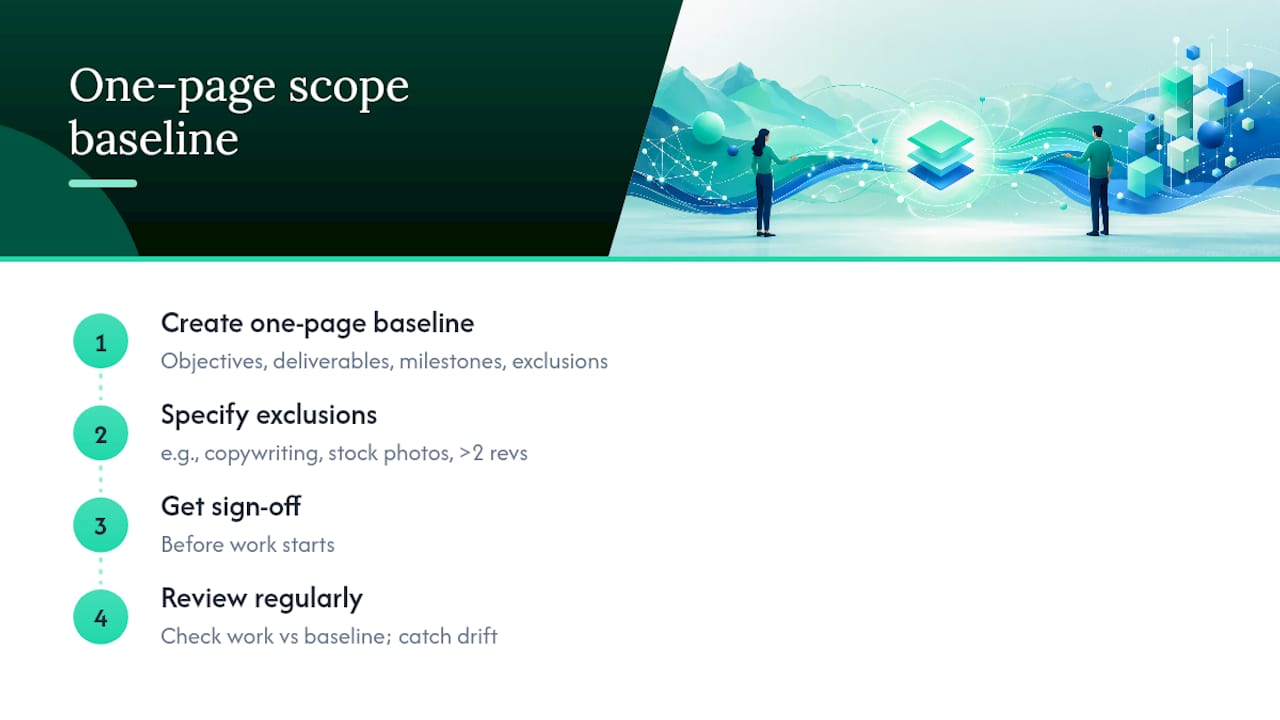
The exclusions list is the piece almost everyone skips, and it's the piece that prevents the most disputes. If you're building a website, write down that the scope doesn't include copywriting, stock photo licensing, or more than two rounds of revisions. Specific exclusions like these are what a scope creep guide points to as the most overlooked and most valuable part of any scope document. Get sign off on this baseline before work starts, not after.
Assign roles before the first request lands
Decide, in writing, who can request changes, who approves them, and who logs the decision. One person's job is to hold the line, and that person needs actual authority to say "not without a trade-off."
Design a change process light enough to survive contact with reality
- Build a one-page change-request form: what's being asked, why, and by when.
- Attach a quick impact estimate, even a rough one, before any conversation about approval.
- Route it to a named decision maker, not a group chat.
- Update the baseline the moment a change is approved, and tell the whole team.
Review scope on a rhythm, not a whim
Milestone scope reviews and a fortnightly scope check take fifteen minutes and catch problems while they're still small. A simple dashboard that links tasks to remaining capacity does more to prevent overcommitment than any policy document ever will.
Pro Tip: Set a small allowance for genuinely trivial asks, which some firms commonly set as a low percentage of the project fee. Log everything under that threshold instead of pricing it, but track it, because ten "trivial" asks add up fast.
None of this needs new software or a process overhaul. Most teams can embed it directly into an existing project tool or client onboarding checklist, which is usually the faster path to adoption anyway.
The Four-Step Decision Flow for Every New Request
When a request lands, whether it's a client email or a teammate's "quick idea," running it through the same four steps every time keeps the decision objective instead of emotional.
- Capture it in writing. Who's asking, what exactly they want, why, and by when. No verbal agreements, no "we'll figure it out."
- Run a quick impact estimate. You don't need a full re-plan. A rough gut check on schedule, cost, and who has the hours to do it is usually enough to move the conversation forward.
- Present the actual trade-off. "We can add this, but it pushes the deadline by five days" or "This adds $600 to the invoice" turns an abstract favor into a concrete decision. Adobe's research on scope creep found that most requests are small and reasonable in isolation, and that presenting the real cost of a change often causes stakeholders to withdraw the request voluntarily.
- Record the decision and update the baseline. Whether the answer is yes, no, or "not this phase," write it down and tell the team immediately.
A sample line that works better than most PMs expect: "I can absolutely get you that, and here's what it does to the timeline. Do you want to move forward, or should we save it for phase two?" That question isn't a rejection. It's a decision, framed honestly.
- A one-line change-request template: request, requester, business reason, estimated impact, decision, date.
- A "sustaining backlog" for good ideas that don't fit the current phase, so nothing gets lost, and nothing derails the baseline either.
The Numbers That Tell You Creep Is Happening
Scope creep is measurable well before it's a crisis, if you're tracking the right things.
- Planned versus actual hours per task, reviewed weekly, not just at the end.
- Budget variance against the original estimate.
- The count of unapproved requests floating around outside the change process.
- Deliverable completion drift, meaning how far actual output has wandered from the original spec.
A useful habit borrowed from agency operations: firms that link scope, capacity, and budget in one place make the cost of change visible before anyone agrees to it, which changes the conversation entirely.
Set a threshold that triggers action. If unapproved hours exceed a modest share of the budgeted total for a phase, or if multiple informal requests pile up within a short period, that's your cue to run a formal scope check rather than waiting for the next scheduled review.
What to Do When Creep Has Already Taken Hold
If you're reading this because scope has already drifted, the fix isn't punishment. It's a structured reset.
- Inventory everything that's been added. List each request, the hours it consumed, and who asked for it. This isn't about blame; it's about having real numbers for the next conversation.
- Build three concrete recovery options. Renegotiate the fee or timeline to match the work actually delivered. Cut or defer scope items to fit the original budget. Or add resourcing, with a clear cost attached, to absorb the extra work without slipping the deadline.
- Bring the numbers, not a complaint, to stakeholders. "We've absorbed 40 extra hours across six requests. Here are three ways forward" gets a decision. A vague conversation about frustration doesn't.
Retroactive billing for work already given away rarely lands well and collects little, according to ScopeDocket's analysis of scope creep costs. The better move is to stop absorbing new work immediately and require approval for everything from this point forward, even while you're still negotiating what happened before.
Turning Scope Control Into a Visible Record
A client portal doesn't replace the discipline above. It gives that discipline a home. When every request, approval, and file lives in one branded workspace instead of scattered across email threads and group chats, there's no ambiguity about who asked for what or when it was approved.
Every request gets a timestamp. Every approval gets a signature. And every change order ties directly to the invoice it affects, so nobody's guessing later whether extra work was authorized or just absorbed. That link between approval and billing is what closes the loop most freelancers and small agencies leave open.
- Show clients the portal at kickoff, alongside the signed scope baseline, so expectations are set before work starts.
- Require a signed change order through the portal before starting any out-of-scope work, no exceptions.
- Export approval records at invoicing time, so billing disputes take minutes to resolve instead of days.
- Track milestone completion directly against the deliverables list, so drift shows up immediately.
A Small Trade-Off Conversation That Saved a Project
A web designer I heard about through industry circles was three weeks into a six-week site build when she noticed the project felt behind, without any single request explaining why. She pulled her hours log and found fourteen small, unlogged asks: a new page here, a color revision there, a "can you just also" tucked into six different emails.
She stopped taking new requests over email that afternoon. On the next call, she said two things: "I can do that, and here's what it moves on the calendar," and "Do you want this now, or should we put it in the list for phase two?" The client chose phase two for two of the three items on the call. The project shipped on time.
The rule she kept afterward: no verbal yes without a written trade-off attached, ever again.
— Real
Why a Client Portal Makes Scope Control Easier to Enforce
A change-control process only works if it's easy enough to use every single time, and that's exactly where most freelancers and small agencies fall off the wagon. Some client portal solutions offer a branded workspace where change requests, e-signatures, and invoices live together, so approving a scope change and billing for it stop being two separate headaches.
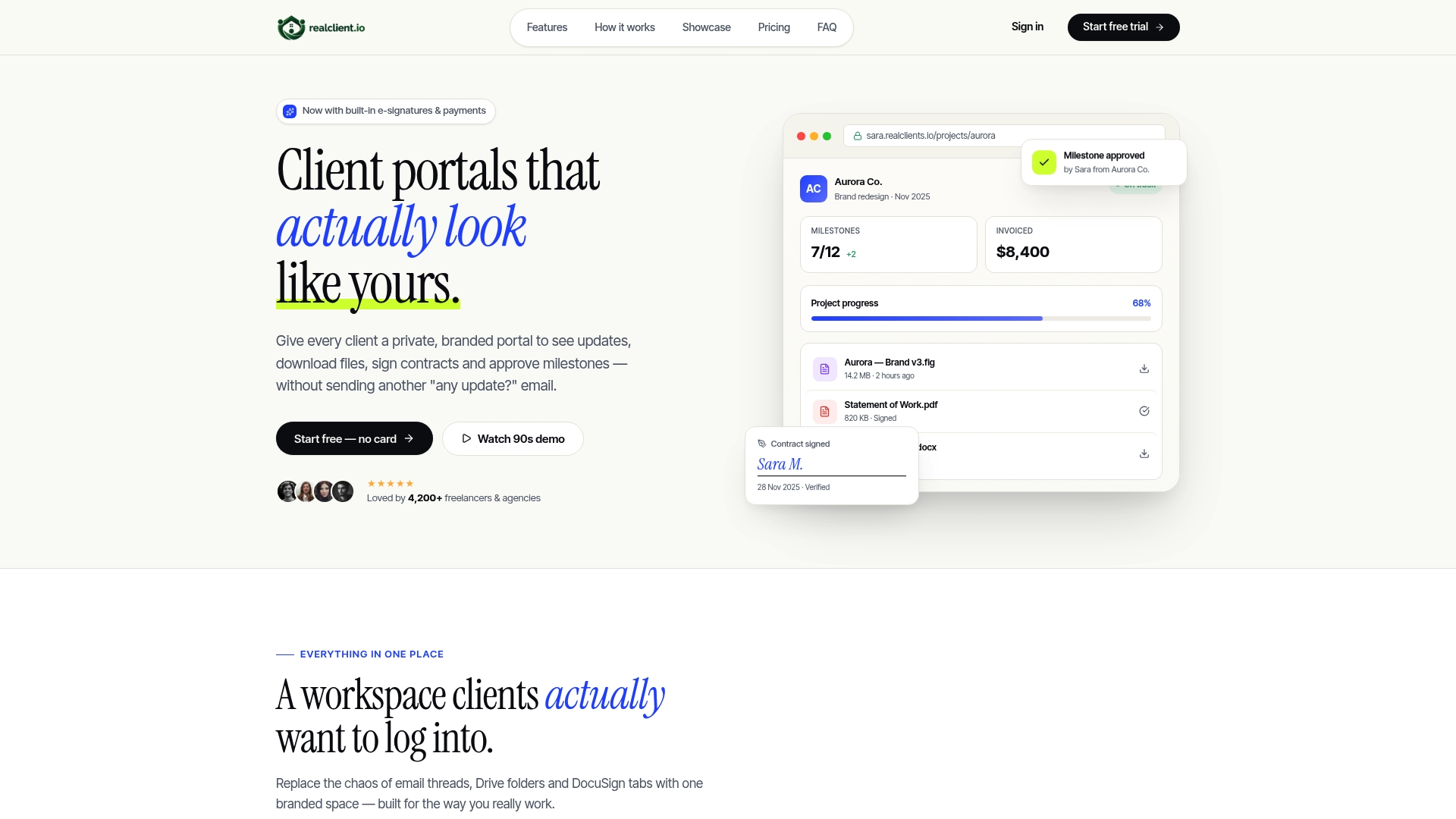
Instead of chasing a client for approval in one thread and payment in another, you send a change request through the portal, they sign it, and the invoice ties directly to that signed approval. Realclient also handles project milestone tracking, file version history, and payment collection through Stripe or PayPal, so the scope baseline you write in your onboarding checklist stays connected to the work and the money throughout the project. If you're tired of scope decisions living in scattered email threads, take a look at Realclient's plans and see whether a branded portal fits how you already work with clients.
Sources
For deeper guidance on scope management, see Atlassian's scope creep guide, Asana's scope creep resource, Adobe's overview of scope creep, and PMI's guidance on controlling scope creep. For engagement best practices, see Ventis Consulting's IT consulting guide.
- Scope creep in project management | Atlassian
- Scope creep in project management: Definition & fixes | Asana
- What is scope creep and how to avoid it | Adobe Business
- Project scope creep: how to spot it and stop it | Magnetic